If you've just raised a venture round and now have budget to build a patent portfolio, the next question is obvious: who should actually do the work?
You could go with a name-brand IP or BigLaw firm, with the deep bench and reputation that come with it — but often at a much higher price and through a fairly traditional, attorney-led process. Or you could use a newer platform that gives you more infrastructure and a faster workflow, at the cost of some of that traditional credibility.
We compared seven of the strongest options for venture-backed startups, including what each is best for, how the experience differs, how they charge, and what you can expect from each as your portfolio grows.
Best patent firms and services for venture-backed startups: an overview
| Firm / service | Type | Best fit if… | Pricing |
|---|---|---|---|
| Patentext | Invention-to-patent platform + practitioner services | You want a modern, async system spanning invention capture through filing — without traditional law-firm overhead. | Annual platform + published flat fees |
| Schox Patent Group | Boutique patent firm | You want a startup-focused firm to take hands-on ownership of invention mining and portfolio development. | Project-based flat fees |
| Fish & Richardson | Large specialist IP law firm | You have a substantial IP budget and want deep prosecution, litigation, and post-grant capabilities. | Hourly + alternative fee arrangements |
| Schwegman Lundberg & Woessner | Specialist IP law firm | You want a prosecution-focused specialist and already have an internal process for surfacing inventions. | Custom outside-counsel pricing |
| Fenwick & West | Full-service technology law firm | You want patents handled by the same firm managing your corporate and financing work. | Hourly + alternative fee arrangements |
| Knobbe Martens | Large specialist IP law firm | You want a deep technical bench for complex or multidisciplinary inventions. | Custom outside-counsel pricing |
| Cooley | Full-service law firm | You want patent counsel closely connected to fundraising, diligence, and M&A support. | Hourly + custom prosecution arrangements |
Disclaimer: Patent costs vary significantly based on the complexity of the technology and who performs the work. Most traditional firms do not publish standard patent application prices. Where pricing information is included below, it reflects publicly available information and is not a quote or commitment from any provider.
7 best patent firms and services for venture-backed startups
1. Patentext
Type: Invention-to-patent platform + practitioner services
Best fit if: You're a venture-backed startup that wants to build a serious patent portfolio without the cost, meetings, and friction of the traditional patent process.
Pricing: Annual platform + published flat fees
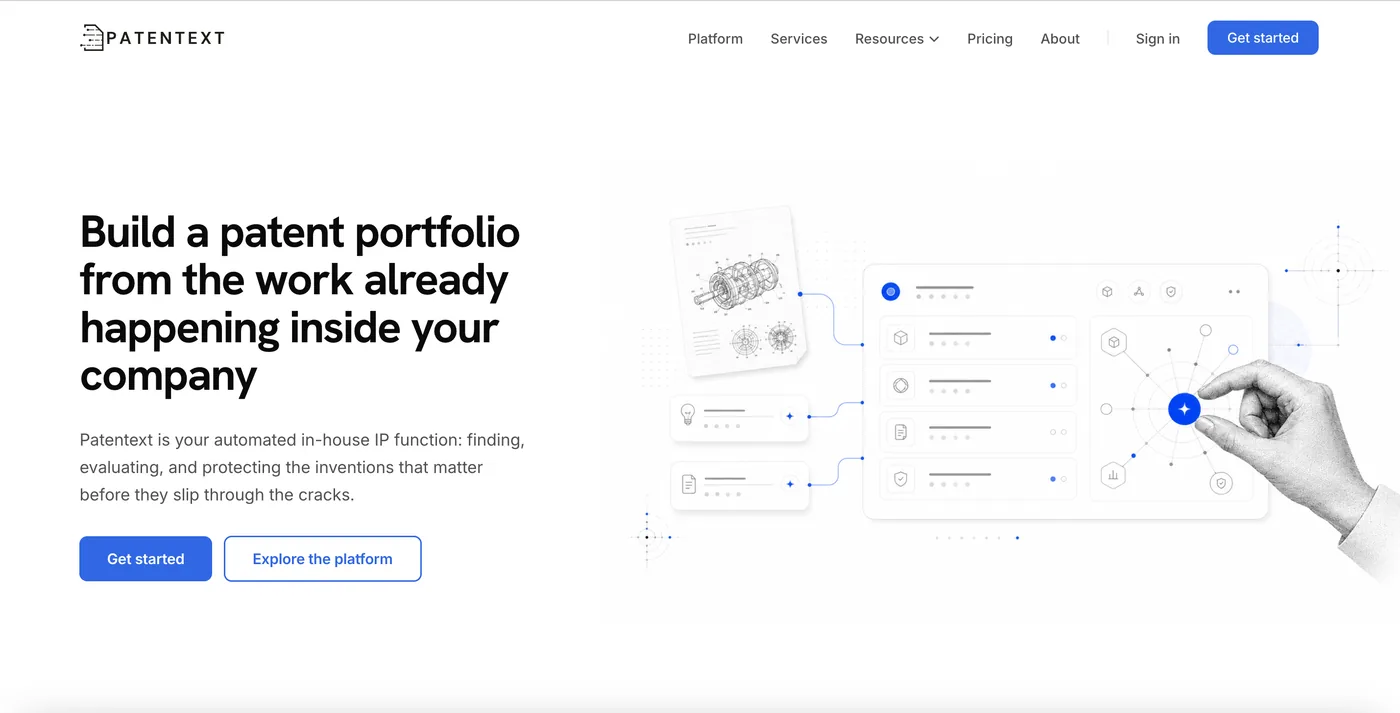
Patentext is designed for startups that need to build IP without slowing down the people actually building the company. Instead of treating every patent as a new outside-counsel project, Patentext creates a continuous system that connects invention capture, portfolio strategy, application drafting, and filing into one workflow.
There are four parts to how it works in practice for a venture-backed company:
- Find patentable inventions earlier. The Patentext platform helps teams surface potential inventions from the work already happening across product and engineering, rather than relying on periodic disclosure meetings or inventors self-reporting after the fact.
- Build a patent strategy around the business. Once patentable inventions are surfaced, the platform helps teams compare them against commercial priorities, product direction, and the parts of the technology that are hardest for competitors to replicate — so filing decisions reflect actual business value rather than what was easiest to write up.
- Keep engineers out of unnecessary meetings. Once an invention is green-lit, inventors contribute directly in the platform and respond to structured prompts asynchronously. That reduces recurring disclosure meetings and the back-and-forth that typically slows prosecution at traditional firms.
- Move from technical context to a filed patent faster. Patentext Services' USPTO-registered practitioners draft from the technical information already captured in the platform rather than recreating context from scratch on a blank page. That compresses the time between an invention and a filed application.
Pros of Patentext
- Built for startups that need to scale patent activity without building an in-house patent department.
- One system spans invention capture, strategy, drafting, filing, prosecution, and portfolio management.
- Fully async workflow minimizes meetings and interruptions for technical teams.
- Published flat-fee services make patent spend easier to forecast as filing volume grows.
- Technical context stays attached to each invention instead of being reconstructed for every new matter.
- Portfolio visibility makes it easier to understand what the company is protecting before financing, diligence, or an acquisition.
- The platform can still be used alongside existing outside counsel for matters that need specialist legal support.
Cons of Patentext
- Not a full-service law firm; companies still need attorneys for work such as litigation, licensing agreements, and broader corporate matters.
Bottom line: Patentext is best for venture-backed startups that want to build a real patent portfolio without importing the traditional law-firm workflow along with it.
2. Schox Patent Group
Type: Boutique patent firm
Best fit if: You want a startup-focused patent firm that can take a hands-on role in invention mining and portfolio development.
Pricing: Project-based flat fees
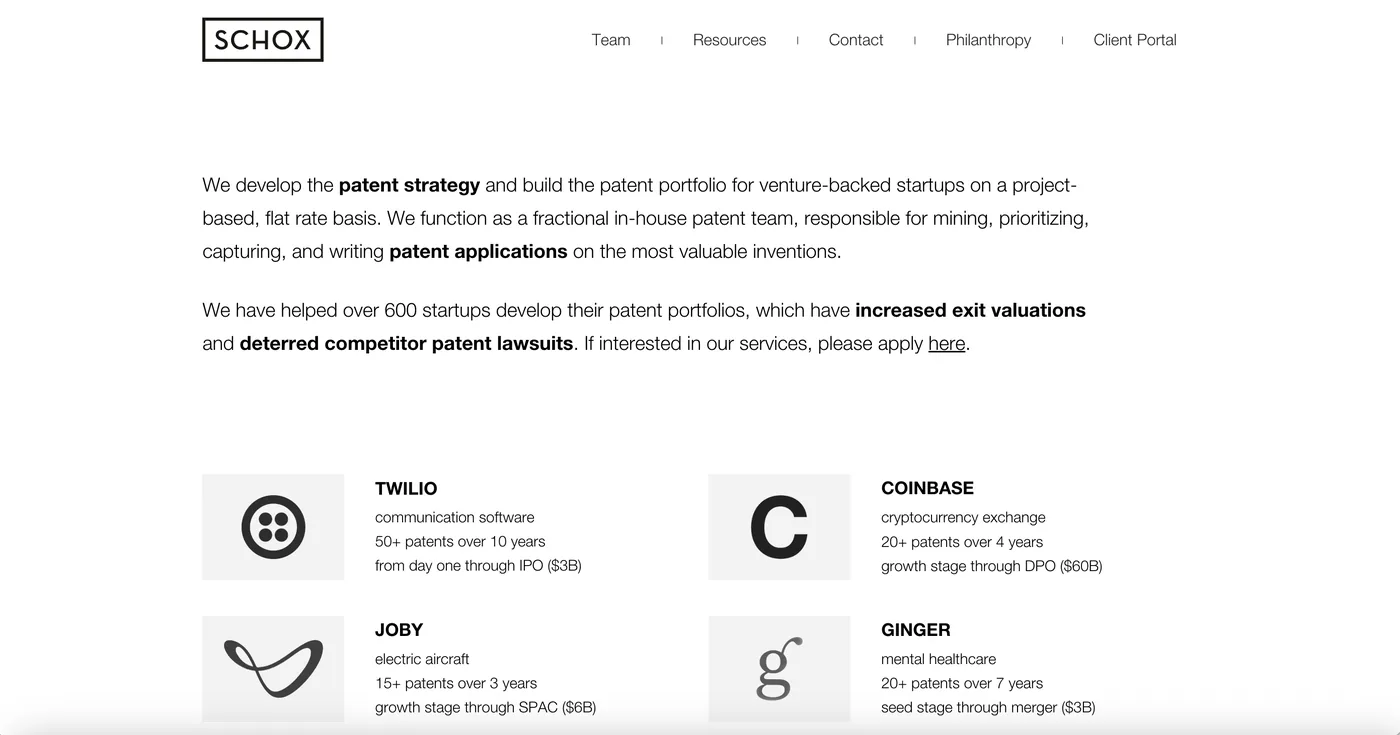
Schox describes itself as a fractional in-house patent team for venture-backed startups, with involvement that starts well before application drafting. The firm helps companies surface inventions, prioritize what may be worth protecting, capture technical information, and build the resulting portfolio. That can be useful for startups that do not yet have a reliable internal process for identifying and moving inventions toward filing.
The main difference from Patentext is how that early-stage work gets done. Rather than giving the company a shared platform to continuously capture, evaluate, and move inventions through the pipeline, Schox conducts regular inventor interviews and manages the discovery process through direct engagement with the Schox team. That can take more burden off the startup internally, but it also means the process remains more dependent on outside people and the firm to keep the patent pipeline moving.
Pros of Schox
- Built specifically around venture-backed startups.
- Strong involvement in invention mining and portfolio strategy.
- Can effectively fill the gap before hiring dedicated in-house patent counsel.
- Project-based flat fees offer more predictability than purely hourly billing.
Cons of Schox
- Pricing requires a custom quote.
- The model depends more heavily on ongoing interaction with outside counsel and inventors.
- Companies with strong internal patent processes may not need to outsource as much of the function.
Bottom line: Schox makes sense when you want an experienced outside team to take significant ownership of the patent function rather than building more of the process internally.
3. Fish & Richardson
Type: Large specialist IP law firm
Best fit if: You have a substantial IP budget and want a premium traditional firm with deep prosecution, litigation, and post-grant capabilities.
Pricing: Hourly billing + alternative fee arrangements
Fish & Richardson is one of the largest and best-known specialist IP firms in the U.S. Its appeal is depth: a company can use the same firm to build a patent portfolio and later handle the more complex work that comes with a mature portfolio — including post-grant proceedings, licensing disputes, and litigation. That makes Fish especially relevant for startups in patent-heavy or highly competitive markets, where the portfolio may eventually need to do more than support fundraising or diligence.
Fish offers alternative fee arrangements, including fixed, blended, and collared structures, but the underlying experience is still a traditional outside-counsel one. The company typically brings a defined group of inventions to the firm, works through attorney-led disclosure calls and drafting review, and manages the matter as it moves through prosecution.
Pros of Fish & Richardson
- Deep technical and legal bench across a broad range of industries.
- Strong prosecution, litigation and post-grant capabilities under one roof.
- Well suited to high-value portfolios where patents may later need to support enforcement or licensing.
- Alternative fee structures are available.
Cons of Fish & Richardson
- Premium specialist-firm pricing can be difficult to justify for routine filings.
- The company still needs a reliable internal process for surfacing and handing off inventions.
- Startups without significant litigation or enforcement needs may not need the full breadth of the platform.
Bottom line: Fish is strongest when the stakes around the portfolio justify premium specialist counsel and deep litigation-ready IP expertise.
4. Schwegman Lundberg & Woessner

Type: Specialist IP law firm
Best fit if: You want a traditional prosecution-focused IP firm and already have an internal process for identifying inventions and handing them off to counsel.
Pricing: Custom outside-counsel pricing
Schwegman Lundberg & Woessner, or SLW, is a specialist IP firm with a strong focus on patent prosecution. It's a good fit for companies that already have corporate counsel elsewhere and want a separate, prosecution-focused practice handling their patent matters. One thing that distinguishes SLW from a smaller boutique is its investment in prosecution systems and technology, which can help deliver more consistency at higher filing volumes.
The engagement model is still traditional. The company generally identifies inventions internally, hands them off to outside counsel, and then works through an attorney-led disclosure, drafting, and review process.
Pros of SLW
- Patent prosecution is central to the firm's business.
- Deep bench of patent attorneys and agents with technical backgrounds.
- Can support substantial filing volume and growing portfolio complexity.
- Makes sense when corporate and financing counsel are already handled elsewhere.
Cons of SLW
- Pricing is not publicly listed.
- The company still needs an internal mechanism for surfacing inventions before they reach counsel.
- The workflow remains centered on outside-counsel matters rather than an internal invention-to-patent system.
Bottom line: SLW is a strong fit if you want a traditional specialist patent firm and already have the internal infrastructure needed to feed it a steady pipeline of inventions.
5. Fenwick & West
Type: Full-service technology law firm
Best fit if: You want patents handled by the same large firm managing your financing, corporate and transactional work, and you're comfortable with BigLaw pricing.
Pricing: Hourly billing + fixed-fee, task-based and other alternative fee arrangements
Fenwick is the heavyweight option for startups that want patent counsel under the same roof as the rest of their legal work. The firm prosecuted the first foundational patents for companies including Apple and Facebook. For a venture-backed company already using Fenwick for corporate or financing work, that can be appealing: the patent team already sits inside a firm that understands the company's fundraising, transactional context, and long-term trajectory.
The tradeoff is price and process. You pay for a top-tier BigLaw relationship, and the patent workflow remains conventional: inventions are typically surfaced internally, then handled through attorney-led disclosure calls and drafting review.
Pros of Fenwick
- Deep experience with venture-backed technology companies.
- Patent strategy can be coordinated with financing, corporate and transactional work.
- Useful when the same legal team needs visibility across the company's broader growth strategy.
- Alternative fee arrangements are available.
Cons of Fenwick
- BigLaw pricing can be difficult to justify for routine prosecution alone.
- The integrated model is less valuable if your corporate counsel is already elsewhere.
- Patent workflow still depends on bringing discrete matters to outside counsel.
Bottom line: Fenwick is best suited to startups that value having patents tightly connected to their broader corporate and financing relationship.
6. Knobbe Martens

Type: Large specialist IP law firm
Best fit if: You want a traditional specialist firm with a deep technical bench for complex inventions and are willing to pay for that depth.
Pricing: Custom / traditional outside-counsel pricing
Knobbe Martens is a large specialist IP firm known for deep technical expertise. That makes it a strong fit for companies with complex inventions or portfolios that span multiple technical disciplines. Compared with a smaller boutique, the advantage is access to a much broader technical bench and the resources of a large IP practice.
Like the other big law firms on this list, the engagement itself is more conventional. Companies typically bring identified inventions to the firm, then work through attorney-led disclosure calls, drafting, and prosecution review.
Pros of Knobbe Martens
- Deep technical expertise across a large patent team.
- Strong prosecution, diligence, and broader IP capabilities.
- Can support technically complex and multidisciplinary portfolios.
- Specialist IP model without requiring the company to move its corporate work.
Cons of Knobbe Martens
- Pricing is not public.
- Companies still need to identify and surface inventions internally.
- Startups with relatively straightforward filings may not need this level of specialist depth.
Bottom line: Knobbe Martens is a strong choice when technical specialization and sophisticated IP counsel matter more than changing the underlying patent workflow.
7. Cooley

Type: Full-service emerging companies law firm
Best fit if: You want patent counsel under the same roof as fundraising, diligence, and M&A support, and cost is secondary to integration with broader legal counsel.
Pricing: Hourly billing + custom prosecution arrangements
Cooley is another heavyweight option for venture-backed companies that want patent counsel closely connected to fundraising and major transactions. Its patent team has represented companies including Genentech, Illumina, and Tesla, and is deeply embedded in the venture and startup ecosystem.
The draw is that Cooley sees patents through the same lens as the investors, acquirers, and corporate teams that may eventually scrutinize them. That can be especially valuable if you expect the portfolio to play a significant role in future financing, M&A diligence, or licensing negotiations.
You are also buying a broader BigLaw relationship, not just patent prosecution. The day-to-day patent process remains attorney-led, with inventions typically surfaced internally before they move into the Cooley workflow.
Pros of Cooley
- Patent counsel can be tightly integrated with financing, diligence, and M&A work.
- Significant experience reviewing portfolios during major transactions.
- Large technical and legal bench.
- Can support companies from early portfolio formation through later-stage transactions.
Cons of Cooley
- BigLaw pricing can be difficult to justify for routine patent prosecution.
- The integrated model is less valuable if the company already uses another corporate firm.
- Invention capture and handoff still generally happen before outside counsel becomes involved.
Bottom line: Cooley is particularly well suited to companies that want patent work deeply connected to fundraising, diligence, and major transactions.
Which patent counsel model is right for your startup?
The right model depends less on which firm has the biggest name and more on how you expect patents to fit into the company as it grows.
If you only need one or two patents
A strong independent patent attorney or smaller IP boutique may be perfectly adequate. If patent work is still occasional, you may not need a system designed around an ongoing invention pipeline.
If you expect patents to become an ongoing part of the business
Patentext is built for venture-backed startups that want to manage patents as a continuous process rather than a series of one-off legal matters.
Potential inventions can be surfaced as product and engineering work happens, evaluated against the company's commercial priorities, developed asynchronously with inventors, and then moved directly into drafting, filing, and prosecution. The same platform keeps the broader portfolio visible as filing volume grows.
That makes Patentext particularly relevant if you expect to generate multiple patentable inventions over time but do not want disclosure meetings, email chains, and outside-counsel handoffs to become the operating system for your patent program.
If you want to outsource most of the patent function
A startup-focused boutique like Schox can take a more hands-on role in invention mining, prioritization, and portfolio development. This can make sense if nobody internally has the bandwidth to run the patent process and you prefer a high-touch services model.
If you want patents bundled with the rest of your legal work
Fenwick or Cooley may make sense if you already use the firm for corporate or financing work and want your patent counsel under the same roof. You are paying BigLaw rates, but the benefit is tighter integration with fundraising, diligence, M&A, and other major legal matters.
If you primarily want deep traditional patent expertise
Fish & Richardson, Schwegman Lundberg & Woessner, and Knobbe Martens offer large, technically sophisticated patent practices. These firms are particularly relevant when you already have a process for surfacing inventions internally and want experienced outside counsel to take over once a matter is ready.
This article is for informational purposes only and does not constitute legal advice. Patent laws are complex and vary by jurisdiction. For guidance specific to your company and technology, consult a qualified patent attorney or agent.