Have an invention you want to protect, but feeling overwhelmed trying to find someone to prepare and file a patent application? A search for online patent filing services turns up everything from inexpensive templates and filing platforms to patent agents, boutique law firms, and major national practices.
The right choice depends on how much help you need. Some services simply give you documents to complete and file yourself. Others connect you with a practitioner or take full responsibility for drafting the application from beginning to end. Prices can range from a few hundred dollars to well over $10,000, and the lowest advertised price rarely tells the whole story.
We compared 8 online patent filing services based on who prepares the application, what the quoted price includes, the level of professional involvement, and the type of filer each one is best suited for. If you're still deciding whether to file at all, our guide on patent strategy for startups covers how to evaluate what's worth protecting before committing to a filing.
What types of online patent filing services are available?
Not every patent filing service works the same way, and understanding the model matters as much as comparing prices.
Registered patent agent or attorney-led services pair inventors with a USPTO-registered professional who leads drafting, claim development, filing, and often prosecution. The practitioner is professionally accountable for their role, while inventors and applicants remain responsible for providing accurate information and reviewing the application. Pricing is typically flat-fee or hourly.
Software-plus-professional services use AI or structured workflows to accelerate parts of the process — including prior art research, disclosure capture, and initial drafting — while a registered patent agent or attorney reviews and finalizes the application. The software compresses timelines and reduces founder involvement without removing professional accountability.
Online legal-service marketplaces connect users with attorneys through a platform, handling intake, payment, and communication. The quality depends on which attorney is assigned and how much time the fee structure supports.
DIY filing and document-generation services provide templates, guides, or AI-generated text that the inventor uses to prepare and file an application independently. These are the lowest-cost option, but the inventor bears full responsibility for application quality.
Traditional patent firms with remote delivery are conventional law firms that accept clients online but operate with standard hourly billing, partner-associate structures, and enterprise-grade resources.
Quick comparison
| Option | Best for | Who prepares the application? | Filing included? |
|---|---|---|---|
| Bold Patents | Inventors who prefer a conventional remote law-firm engagement with flat-fee pricing | Patent attorney | Yes |
| Patentext | Startups and growing companies that want patent strategy, drafting, and filing in one place | USPTO-registered patent agent | Yes |
| Lightbringer | Technology companies seeking an ongoing, software-supported patent service across Europe and the U.S. | Patent attorneys | Yes |
| iPNOTE | Comparing providers across jurisdictions | Marketplace professional selected by the client | Depends on proposal |
| PatentPC | Technology startups seeking boutique counsel | Patent attorney | Yes |
| Quick Patents | Professional review or expedited practitioner support | Patent practitioner | Depends on engagement |
| Rocket Lawyer | A DIY provisional template | Applicant | No |
| LegalZoom | Filers prioritizing a familiar, standardized platform | Assigned registered practitioner | Depends on package |
8 best online patent filing services in 2026
1. Bold Patents: a remote flat-fee patent firm
Service model: Traditional patent firm with remote delivery

Bold Patents is a nationwide patent and trademark law firm that works with clients remotely and uses flat-fee engagements for services including patentability searches, provisional and non-provisional applications, and prosecution.
Strengths
- You work with a patent law firm rather than a document-generation platform
- Offers patent searches, application preparation, filing, and prosecution
- Remote process is available to inventors and businesses across the United States
- Flat-fee engagement structure can be more predictable than open-ended hourly billing
- Handles both patent and trademark matters
Limitations
- Published educational cost ranges are broad, and prospective clients need a matter-specific quote to understand the complete cost
- No software platform for invention capture, portfolio planning, or managing a continuing pipeline of filing candidates
- Search and opinion services depend on the scope of the search and the depth of the practitioner's analysis; clients should ask to see a sample deliverable and understand how conclusions will be explained
- The firm appears oriented primarily toward individual inventors and small businesses rather than companies building a repeatable internal patent process
Pricing: Bold Patents describes its work as flat-fee but does not publish a simple current application-price menu. Its educational materials describe provisional applications as commonly costing approximately $4,000 to $10,000 or more and non-provisional applications as approximately $5,000 to $20,000, depending on the technology and scope.
Best for: Inventors who prefer a conventional remote law-firm engagement and are willing to obtain a matter-specific quote and evaluate the proposed scope carefully.
2. Patentext: best for startups and growing companies
Service model: Software-plus-professional patent service
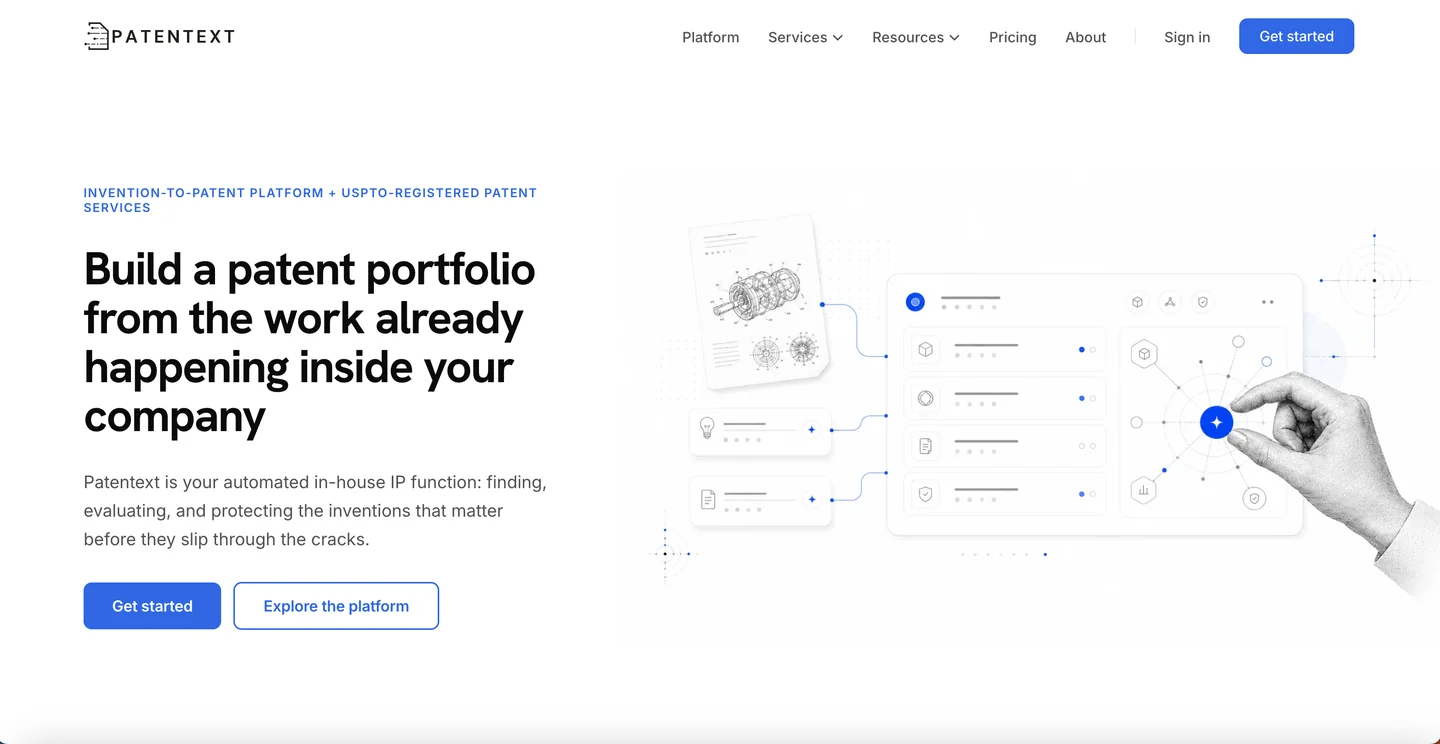
Patentext combines patent strategy software with application drafting, filing, and prosecution services delivered by USPTO-registered patent agents through its Services arm. Unlike services built around completing one standalone application, Patentext is designed to support the broader process of deciding what to protect, developing inventions into filing-ready disclosures, preparing applications, and maintaining continuity as the company's patent needs grow.
This makes Patentext closer to an all-in-one patent tool than a conventional online filing package. A company can use it for a single application, but the platform becomes more valuable when patent decisions continue over time and each new matter needs to fit into a broader strategy.
Strengths
- Covers more of the patent process than application preparation alone — including strategy, invention disclosure, filing decisions, drafting, filing, and prosecution. Technical and business context carries into the drafting process, reducing repetitive intake and information loss between stages.
- Applications are prepared and reviewed by USPTO-registered patent agents through Patentext Services.
- Fast turnaround compared with traditional patent-firm processes.
- Fully asynchronous with no required meetings; founders and technical teams can provide information and review drafts on their own schedules.
- Published flat-fee application services make it easier to forecast patent spending.
Limitations
- Because Patentext is a registered patent agency, not a law firm, matters requiring legal opinions, litigation, licensing representation, infringement analysis, or other attorney-only services may require separate counsel.
- Patentext is newer and has a shorter public operating history than long-established law firms and legal-service brands.
Pricing
- Free account and initial patent strategy session
- Discovery plan: $2,700/year for ongoing strategy and invention-disclosure workflows
- Provisional patent application through Patentext Services: $3,600
- Non-provisional patent application through Patentext Services: $4,700-$5,700
Best for: Startups and growing companies that want strategic help deciding what to protect, professional drafting and filing, and an ongoing system for managing future inventions — without hiring a full in-house patent team.
3. Lightbringer: an AI-enabled patent firm expanding into the U.S.
Service model: Software-plus-professional patent service

Lightbringer is a Swedish patent-services company that combines an AI-enabled platform with application drafting, filing, prosecution, and portfolio support from patent attorneys. It has built its business primarily in Europe and only recently began making a concerted expansion into the United States.
Like Patentext, the platform guides clients through invention capture and provides visibility into active patent matters, while Lightbringer's practitioners handle the professional patent work. Unlike services priced around a single provisional or non-provisional application, Lightbringer uses a recurring per-application subscription model.
Strengths
- Combines software with professional drafting, filing, and prosecution support
- Provides a centralized dashboard for active patent matters
- Uses published fixed pricing rather than hourly billing
- Supports international patent portfolios from a single platform
- Focuses on technology and deep-tech companies
Limitations
- Lightbringer's U.S. operation is newly established, so it has a much shorter track record serving U.S. applicants than established domestic providers
- Pricing is charged monthly for each patent application, which can accumulate over the life of a multi-application portfolio
- The ongoing subscription model may be less attractive for a company seeking one discrete application
- Much of its publicly visible customer base and operating history remains European
Pricing: Lightbringer publishes pricing of €249 to €499 per patent application per month, depending on portfolio size. Companies should calculate the expected total over the period each application will remain under management rather than comparing the monthly figure directly with a one-time filing fee.
Best for: Technology companies that want a continuing, attorney-supported patent platform and may benefit from managing filings across Europe and the United States.
4. iPNOTE: best for comparing patent professionals through a marketplace
Service model: Online legal-service marketplace
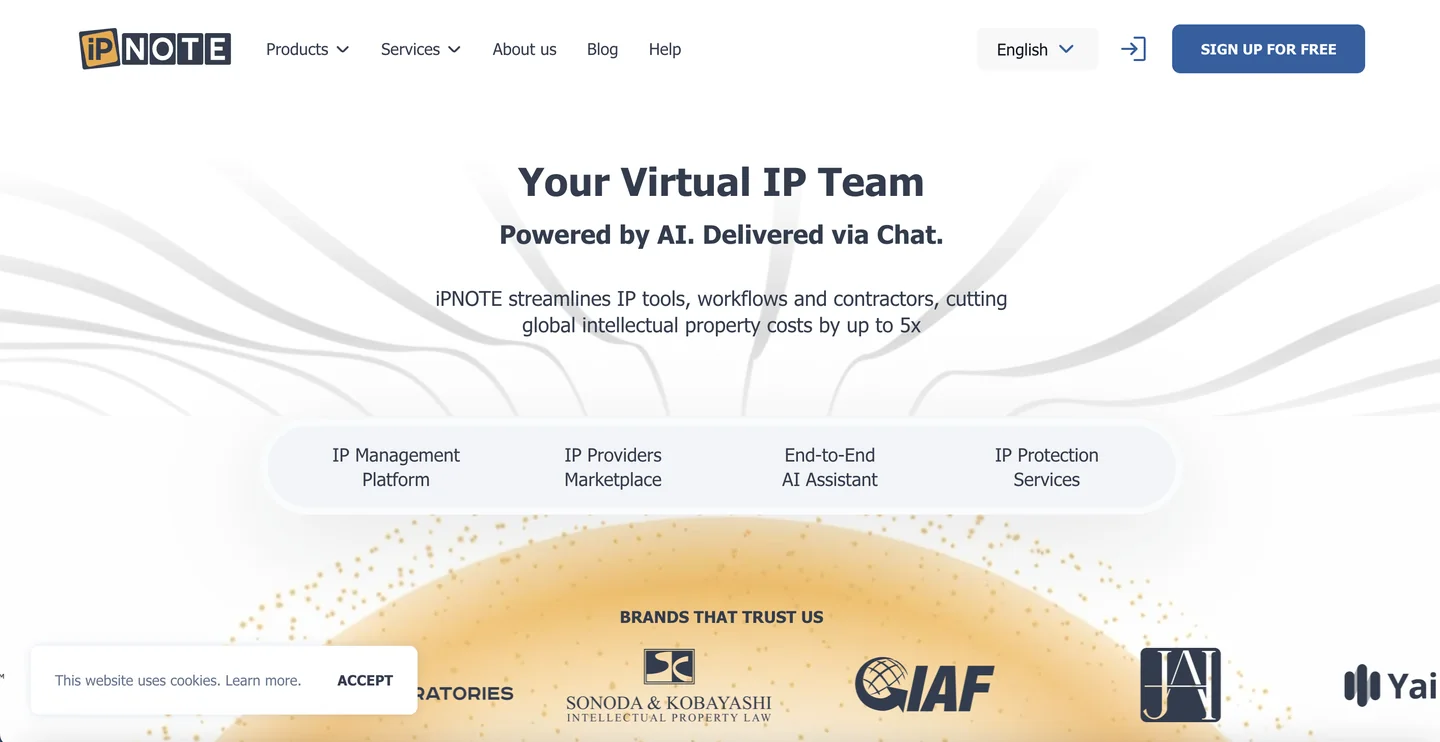
iPNOTE positions itself as a marketplace for IP services, connecting companies with patent attorneys worldwide. The platform uses an AI assistant to help users create a structured request, then generates offers from attorneys in the platform's network.
Strengths
- Ability to compare proposals from multiple practitioners
- Broad international reach
- Centralized communication and project tracking
- Useful where local counsel is needed in several jurisdictions
Limitations
- Quality depends entirely on the attorney selected; iPNOTE facilitates the connection but doesn't draft the application itself
- Less suited for companies that want a single, consistent practitioner relationship across multiple filings
- Platform is strongest for international trademark and patent registration; U.S.-specific prosecution depth may vary by attorney
- Quotes may not be directly comparable in scope
Pricing: iPNOTE lists U.S. patent registration services starting from $1,200 plus government fees starting at $332. Because iPNOTE is a marketplace, the final proposal depends on the selected professional, application type, technical complexity, and requested services.
Best for: Companies that want to compare patent professionals across multiple countries.
5. PatentPC: best for technology startups seeking boutique patent counsel
Service model: Registered patent attorney-led service (boutique firm)

PatentPC is a boutique patent firm that positions itself specifically for technology startups and growth-stage companies. The firm emphasizes working with founders who are building products in software, AI, fintech, and other technology-heavy categories, and focuses on strategic claim development rather than volume-based filing.
Strengths
- Technology-focused practice with specialization in software, AI, and startup IP
- Direct attorney relationships with a smaller team
- Emphasis on strategic claim development and portfolio planning
Limitations
- No self-service or invention-management platform
- The service depends on fit with the specific attorney assigned
- More traditional counsel model than a standardized online filing product
Pricing: Public materials describe non-provisional patent preparation as commonly ranging from about $5,000 to $10,000. Prospective clients must request a matter-specific estimate.
Best for: Technology startups that want a boutique firm and are comfortable with a traditional counsel model.
6. Quick Patents: best for expedited practitioner support
Service model: Registered patent agent-led service
Quick Patents pairs inventors with a team that includes former patent examiners, engineers, and researchers. The firm's differentiator is its emphasis on examiner-side experience — the team understands how applications are evaluated because they've been on the other side of the desk.
Strengths
- Full application preparation by a practitioner-led team
- Former-examiner perspective on how applications are reviewed
- Multiple patent types supported
- Expedited turnaround options with published pricing
- Published pricing for several services
Limitations
- More transactional than a continuing portfolio-management relationship
- Smaller operation without the platform infrastructure of marketplace or software-led services
- Ongoing prosecution appears separately scoped
Pricing
- Patent application review: $375, excluding USPTO filing fees
- Simple provisional application: $3,995 standard or $5,995 rush, excluding USPTO fees
- Complex provisional application: $4,995 standard or $6,995 rush, excluding USPTO fees
- Simple non-provisional application: $5,995 standard or $7,995 rush, including up to three drawing sheets but excluding USPTO fees
- Complex non-provisional application: $6,995 standard or $8,995 rush, including up to three drawing sheets but excluding USPTO fees
Best for: Inventors who want a practitioner-led filing with expedited options and published pricing.
7. Rocket Lawyer: best budget option for a DIY provisional template
Service model: DIY filing and document-generation service
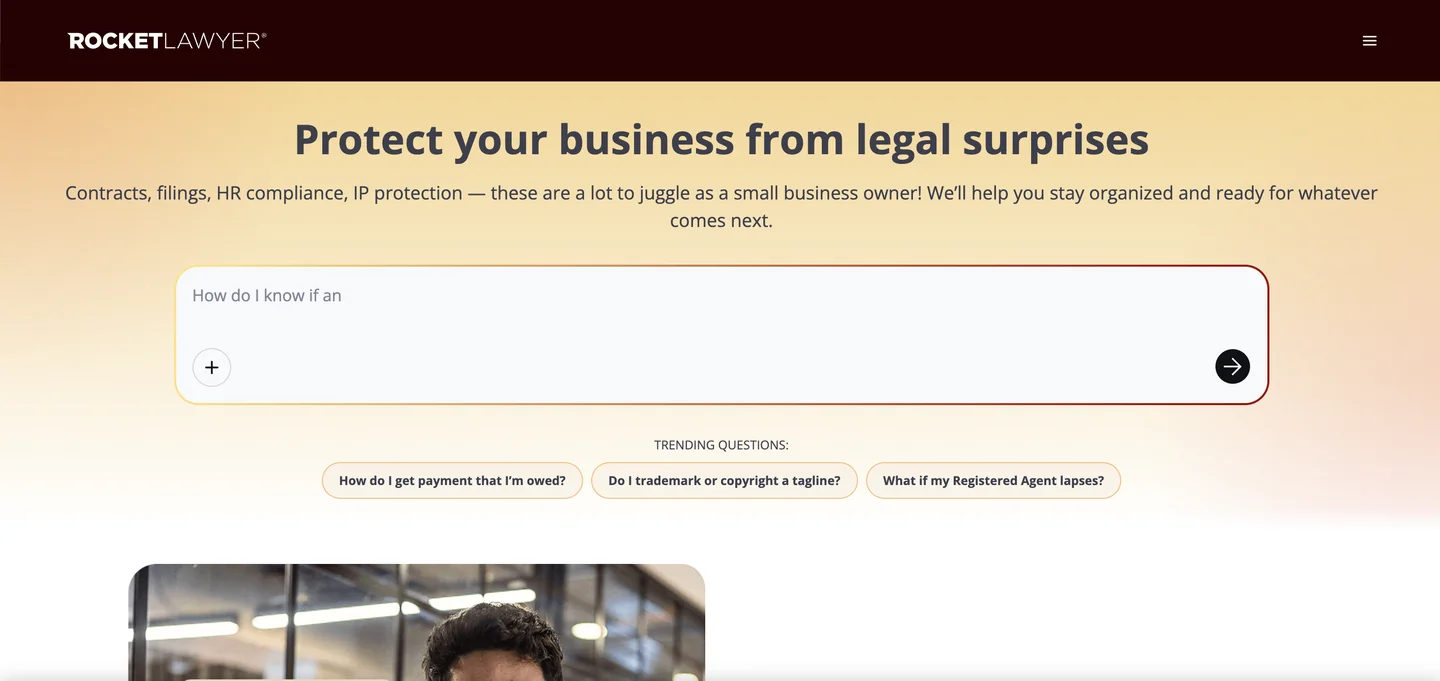
Rocket Lawyer is a membership-based legal services platform that covers a wide range of legal needs, with patent documents among them. For patents, Rocket Lawyer provides a provisional patent application template that the inventor fills out and files independently through the USPTO.
This is an important distinction: Rocket Lawyer provides the document, but does not file the application for you. You are responsible for preparing the content, verifying completeness, and submitting through USPTO Patent Center.
Strengths
- Membership includes access to other legal documents and discounted attorney consultations, useful if patent filing is one of several legal needs
- Simple, template-driven process for straightforward provisional applications
Limitations
- Only provisional patent applications are offered; non-provisional patents are not available through the platform
- Rocket Lawyer generates a document template, but it does not draft the application, review your technical disclosure, or file with the USPTO
- No patent search, claim strategy, or prosecution support
Pricing: Rocket Lawyer's current annual membership tiers are $149/year for Standard, $249/year for Plus, and $349/year for Pro. The membership provides access to the document template; it does not include professional patent drafting or USPTO filing fees.
Best for: Budget-conscious filers who need a provisional application template as a starting point, understand the limitations of self-filing, and are comfortable handling the submission process themselves.
8. LegalZoom: best-known standardized option
Service model: DIY document service and online legal-service platform

LegalZoom is probably the most recognized name in online legal services. The company has operated since 1999 and expanded into patent filings through its law firm, LZ Legal Services.
The level of professional help varies substantially by package. The least expensive option is primarily a guided document-preparation and filing workflow, while higher-priced packages involve a registered patent attorney or agent.
Strengths
- Familiar national brand with a straightforward online purchasing and intake process
- Offers self-guided and practitioner-assisted options at different price points
- Published entry pricing makes it easy to understand how the process begins
- May appeal to individual inventors who are already comfortable using LegalZoom for other legal documents
Limitations
- The $299 self-guided provisional package should not be confused with practitioner-led patent drafting
- A standardized questionnaire may not uncover the alternatives, variations, and technical detail needed to support a strong application
- The advertised entry price does not represent the cost of moving through a professionally prepared non-provisional application
- Different stages are sold separately, which can make the complete cost and continuity of the engagement harder to evaluate
- The platform is designed around completing a particular legal transaction rather than developing an ongoing company-wide invention pipeline
Pricing
- Self-guided provisional application: $299 plus federal filing fees
- Attorney-assisted provisional application: starts at $999 plus federal filing fees
- Non-provisional patent — step one: $699 for the preliminary assessment and drawings; step two: starts at $2,700 plus filing fees (with an additional $1,000 practitioner fee for electronics, software, computer hardware, biological, biotechnology, or chemical inventions)
- Optional non-provisional patent search: $499
- Design patent application: $1,099 plus federal filing fees
The published minimum for a non-provisional application is $3,399 plus filing fees before any technology-specific surcharge or optional search.
Best for: First-time filers who want a standardized, clearly packaged filing service from a familiar brand.
How to choose the right patent filing service
The right choice depends less on star ratings or the lowest advertised price and more on who will prepare the application, how thoroughly they will understand the invention, and whether the service can support what happens after the initial filing.
Who will actually prepare your application?
Patent quality depends heavily on the person responsible for understanding the invention and translating it into a patent application. Confirm whether the work will be handled by a USPTO-registered patent attorney or agent, generated through a self-guided template, or delegated through a marketplace to an assigned practitioner.
How does the service ensure application quality?
A strong patent application needs more than a technically accurate description. It should explain the invention thoroughly, anticipate variations and alternatives, and preserve enough support for claims that may evolve during examination.
Ask how the service gathers technical detail, develops the scope of the invention, handles revisions, and checks that the application reflects more than the inventor's first description of the product. A low-cost filing may be expensive in the long run if the application is too narrow, incomplete, or difficult to rely on later.
Where are you in the process?
If you have a clearly defined invention and already know that you want to file, a practitioner-led drafting and filing service may be enough. If you are still deciding what should be protected, a platform that includes strategy, invention disclosure, or evaluation can help prevent a premature filing that consumes budget without advancing a broader patent strategy.
What happens after the application is filed?
Filing is only the beginning of the patent process. A provisional application generally needs to be followed by a non-provisional application, and a non-provisional application may receive one or more office actions from the USPTO.
Find out whether the provider will track deadlines, handle the next filing, respond to examiner rejections, and maintain continuity across the matter. Some online services end their involvement as soon as the application is submitted, leaving the applicant to find a new practitioner for every later stage.
How much of your team's time will the process require?
The cheapest service may not be the least expensive once founder and engineering time is included. Some providers require multiple meetings, long questionnaires, and repeated explanations of the same technology. Others use asynchronous workflows that let technical teams provide information and review drafts on their own schedules.
Consider both turnaround time and the amount of internal coordination required to reach a filing-ready application.
How many applications do you expect to file?
A single provisional is a different purchasing decision from an ongoing patent portfolio. A one-time filing may work well through a marketplace or boutique firm. Companies expecting continued invention activity may benefit more from a provider that preserves technical context, tracks potential inventions, supports filing decisions, and offers continuity across multiple matters.
Is the pricing complete and predictable?
Compare what each quoted price actually includes. A low starting price may cover only a template, intake assessment, search, or initial filing stage. Drawings, government fees, additional claims, revisions, conversion filings, and office-action responses may be billed separately.
The most useful comparison is not the advertised entry price, but the likely total cost of moving through a professionally prepared application and the first stages of prosecution.
This guide is based on publicly available information from provider websites, product materials, and other cited sources. Service scope, practitioner involvement, pricing, and government fees can change. Confirm current terms directly with each provider before making a purchasing decision. This article is general information and not legal advice.