Try Patentext for free
Bring invention capture, evaluation, drafting, and patent services into one connected workflow.
Schedule a demo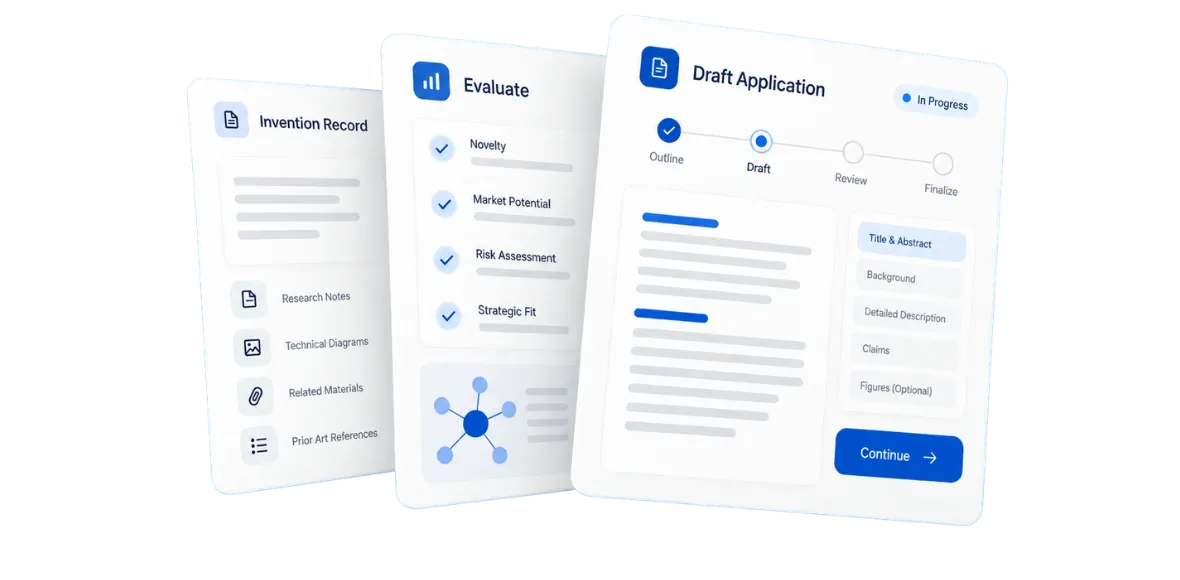
If your team is evaluating Lightbringer alternatives for US patent drafting and USPTO filings, here is what to compare.
Both Patentext and Lightbringer use software to make patent work more efficient. The difference is what each system is built around.
Lightbringer is primarily structured around managing individual patent applications through a lifecycle. Patentext is built around the company's patent pipeline: helping teams capture invention activity, evaluate what is worth protecting, draft and file applications, and track portfolio activity in one connected system.
| Lightbringer | Patentext | |
|---|---|---|
| Core model | A patent lifecycle service for individual applications | A connected patent pipeline platform plus USPTO-registered patent agency services |
| Starting point | Starts when a company is ready to move an idea into patent work | Captures and structures invention activity before drafting begins |
| Invention strategy | Focuses more on managing applications through filing and prosecution | Helps teams evaluate what is worth protecting across the pipeline |
| Drafting workflow | Attorneys draft and manage applications through the service workflow | Patent agents draft from structured invention context already captured in the platform |
| Team workload | Provides managed service support, but the workflow is centered on each application | Designed to reduce intake calls, repeated inventor questions, and scattered review cycles |
| Review experience | Application work is managed through Lightbringer's platform and service team | Drafts, comments, questions, and invention context stay connected in Patentext |
| Pricing philosophy | Recurring per-application pricing, with official filing fees separate | Flat fees by service type, USPTO filing fees billed separately |
| After filing | Prosecution is bundled for covered applications through decision of grant | Track status and portfolio activity in the Patentext platform; add flat-fee prosecution support as needed |
| Best for | Companies that want a managed patent lifecycle service for individual applications | Companies that want to build a repeatable patent pipeline, not just file one-off applications |
Patentext is built for teams that want to manage patentable work before drafting begins, move filing-ready inventions into agent-led drafting, and understand costs upfront.
Patentext service pricing is based on the type of work you need, not a recurring per-application subscription.
USPTO filing fees are billed separately. If unusual government fees, excess claims, extensions, or other non-standard costs apply, Patentext identifies those separately before moving forward.
See pricing →Patentext Services is a registered patent agency. Applications are drafted and filed by USPTO-registered patent agents, with AI used to accelerate the workflow rather than replace practitioner judgment.
Learn more about Patentext's patent application services →Patentext is not just a drafting handoff. The platform helps teams identify, capture, evaluate, and manage patentable work before an application is drafted.
Explore Patentext's invention-to-patent platform →Because each draft starts from organized invention context, Patentext can reduce intake cycles, repeated inventor questions, and manual reconstruction. Drafts are often completed in days, not weeks.
Teams can review drafts, track filing status, and manage portfolio activity in the Patentext platform instead of coordinating patent work across email threads, spreadsheets, and disconnected documents.
Lightbringer may be a good fit for teams that prefer a monthly or annual per-application model with prosecution bundled through decision of grant.
Lightbringer's public pricing lists its Single Patent plan at $599 per application/month, plus official filing fees. It also lists a free platform tier and custom portfolio pricing.
Lightbringer positions its Single Patent plan as an attorney-led service that manages a patent application end-to-end, including work through the decision of grant.
Lightbringer states that official filing fees are required to file and process the application and vary by country and patent office. These fees are listed separately from the monthly service price.
Lightbringer describes its service as attorney-led, with a dedicated team of specialists and patent attorneys handling the application.
Patentext prices patent work as flat-fee services. For example, a non-provisional patent application is $5,700. USPTO filing fees are billed separately.
Lightbringer's public Single Patent plan is $599 per application/month plus official filing fees. That is $7,188 per year before official fees. If an application remains active for two to three years, the subscription alone could total $14,000-$21,500+ before official filing fees.
That recurring model may work well for teams that want prosecution bundled through decision of grant. Patentext may be a better fit if you want a clear upfront filing cost, and flat-fee prosecution support only when needed.
Yes. Patentext is a Lightbringer alternative for companies looking for AI-enabled patent drafting, filing, prosecution support, and patent workflow software.
The biggest difference is the model. Patentext combines a secure patent pipeline platform with USPTO-registered patent agency services, flat-fee filings, and standard Lightbringer offers an attorney-led patent lifecycle service with recurring per-application pricing and official filing fees listed separately.
Patentext may be more predictable for teams that want to understand filing costs upfront. For example, Patentext's non-provisional patent application service is $5,700 (USPTO filing fees billed separately). Lightbringer's public Single Patent plan is $599 per application/month plus official filing fees. That equals $7,188 per year before official fees; over two to three years, the subscription alone could total $14,376-$21,564 before official filing fees.
Lightbringer's recurring model may work well if you want prosecution bundled through decision of grant. Patentext may be a better fit if you want flat-fee filing upfront and flat-fee prosecution support only when needed.
No. USPTO filing fees are billed separately and are not included in Patentext Services' flat service fees. Patentext communicates applicable fees before filing. If a matter requires non-standard government fees, extensions, excess claims, additional filings, or other unusual costs, those would be identified separately before work begins.
Lightbringer's public pricing lists official filing fees separately from its recurring per-application service price. Its pricing page states that official fees are required to file and process the application and vary by country and patent office.
Patentext applications are drafted by USPTO-registered patent agents. AI helps accelerate the drafting process, but Patentext does not hand customers generic AI output and leave them to figure it out on their own. Patent agents draft from the invention context captured in the Patentext platform, so the work starts from a stronger foundation.
Lightbringer describes its Single Patent plan as an attorney-led patent service handled by a dedicated team of specialists and patent attorneys.
Patentext is designed for teams that want more than a one-off patent application. The platform helps capture invention activity, evaluate what is worth filing, move filing-ready inventions into agent-led drafting, and track patent activity after filing.
Lightbringer may be a better fit for teams that want a recurring per-application service model with prosecution bundled through decision of grant.
Yes. Patentext offers flat-fee prosecution support, including office action responses, restriction requirement responses, and pre-grant review.
Patentext also helps teams track application status and related portfolio activity in the platform after filing.
Yes. Teams can use Patentext alongside existing outside counsel. Some companies use the Patentext platform to organize invention activity before sending work to counsel. Others use Patentext Services for specific drafting, filing, or prosecution work while keeping outside counsel involved for broader legal strategy, opinions, licensing, litigation, or international matters.
No. Patentext is built around the full patent pipeline, not just the application draft. The platform helps teams identify, capture, evaluate, and manage patentable work. Patentext Services then turns filing-ready inventions into drafted and filed applications through USPTO-registered patent agents and an AI-enabled workflow. That means teams get faster drafting and lower cost, but also a more organized way to manage IP as the portfolio grows.
Bring invention capture, evaluation, drafting, and patent services into one connected workflow.
Schedule a demo