Your company may be producing more patentable inventions than anyone realizes. Engineers are solving difficult technical problems, developing new systems, and making product decisions that could be worth protecting — but those ideas are easy to miss when nobody is responsible for reviewing the work through a patent lens.
That becomes a larger problem as technical teams grow. A founder, general counsel, or small IP team cannot sit in every design review or know what is happening across every engineering project. By the time an invention becomes visible to the people responsible for IP, it may already have been shared publicly — starting the clock on U.S. filing deadlines without anyone realizing it and potentially eliminating patent rights altogether in countries without a grace period.
Invention mining tools are designed to help companies find these opportunities earlier. Some monitor internal engineering and communication systems for potentially patentable work. Others guide teams through structured reviews or use patent-landscape data to identify areas worth investigating. Here are 6 popular ones.
What is invention mining software?
Invention mining software helps organizations identify potentially patentable ideas within internal technical work, documents, or communications before they enter a formal disclosure process.
Different platforms approach this in different ways. Some scan systems such as Slack, GitHub, Jira, or Google Drive for signs of potentially inventive work. Others guide technical teams through structured reviews of recent engineering and product activity, or use patent and portfolio data to highlight opportunities worth investigating.
Unlike invention disclosure software, which manages ideas after someone submits them, invention mining software is intended to surface ideas that might otherwise never be recognized or recorded. It does not determine patentability on its own; it helps create a more complete pipeline of potential inventions for further evaluation.
Quick comparison
| Tool or approach | Discovery approach | Evaluation and prioritization | Professional drafting and filing | Best for |
|---|---|---|---|---|
| Patentext | Guides teams through technical work to find inventions | Scores ideas against technical and business priorities | Yes, through registered patent agents (Patentext Services) | Growing companies that want discovery through filing in one place |
| IP Copilot | Scans internal tools for invention signals | AI scoring and prior-art context | No | Large engineering teams |
| Tradespace | Mines technical work and communications | Prior art, market, and portfolio analysis | Yes | Companies with in-house IP teams |
| Patlytics | Finds gaps in patent landscapes and portfolios | Advanced patent and competitor analysis | Drafting tools; filing support varies | Sophisticated IP teams |
| Triangle IP | Collects ideas submitted by employees | Scoring and committee review | No | Teams improving disclosure intake |
| InspireIP | Collects ideas submitted by employees | AI screening and committee review | No | Teams formalizing invention disclosures |
1. Patentext: guided invention discovery with filing services
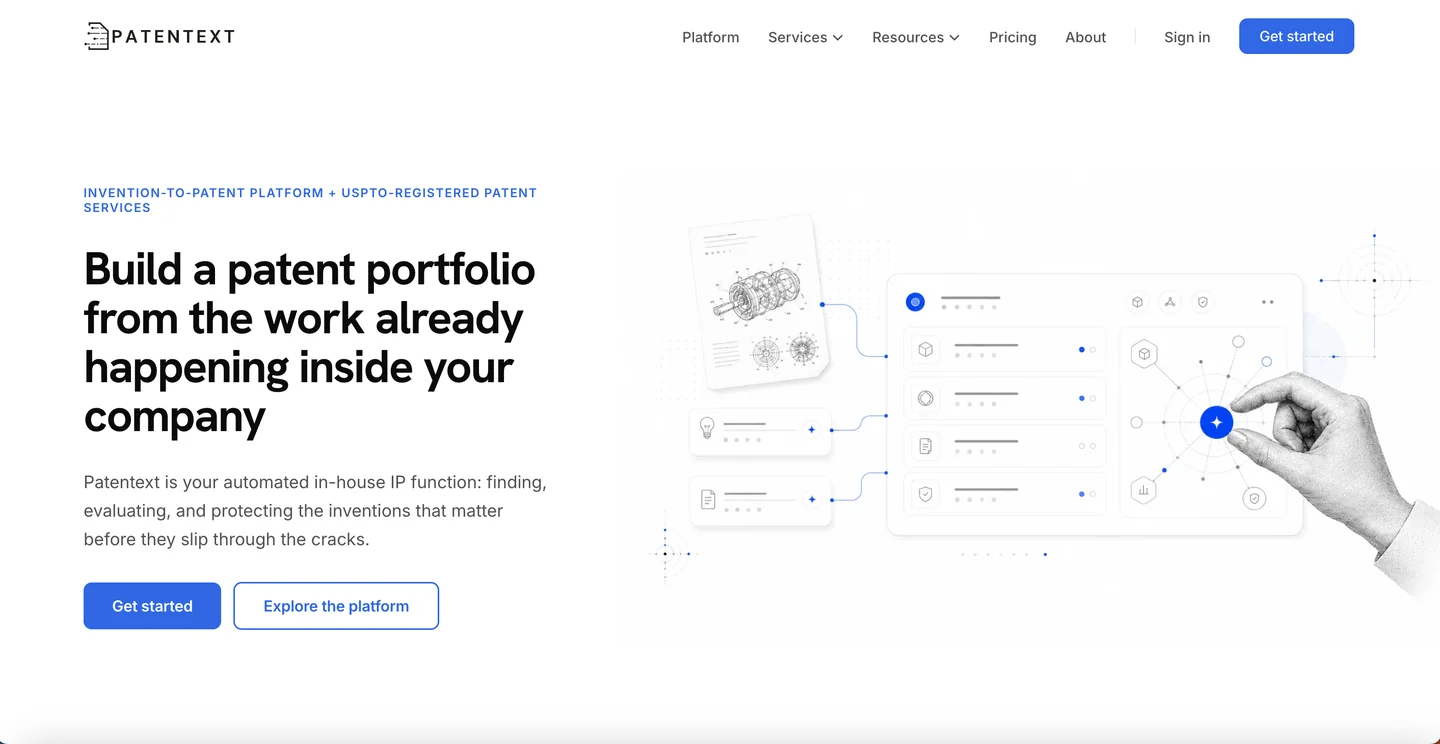
What it is: Patentext is an invention-to-patent platform. It connects to internal systems such as GitHub, Slack, and Google Drive, analyzes the technical work already happening there, and surfaces potential inventions for review. Selected opportunities can then be turned into structured invention disclosures, evaluated inside Patentext, and advanced into drafting and filing through Patentext Services.
Unlike standalone mining tools, Patentext is designed to carry an invention beyond discovery. The same technical and business context follows the matter through disclosure, prioritization, application preparation, filing, and prosecution, with USPTO-registered patent agents handling the professional work.
Pros:
- Connects invention discovery to strategy, structured disclosure, professional drafting, filing, and prosecution.
- Designed for companies that need help both finding inventions and deciding which ones are worth protecting.
- Applications are prepared and reviewed by USPTO-registered patent agents through Patentext Services.
- Supports a fast, fully asynchronous process without requiring repeated inventor meetings.
- Preserves the technical and business context gathered during discovery through the application-drafting process.
Cons:
- Not designed to replace patent intelligence for mature IP departments.
Pricing:Paid platform plans start at $2,700/year (unlimited strategy and disclosures). Filing services priced at $3,600 for provisional applications and $5,700 for non-provisional applications.
Best for: Startups and growing technical companies without dedicated in-house patent counsel that need a repeatable process for identifying, evaluating, and filing inventions.
2. IP Copilot: real-time invention discovery from internal communications
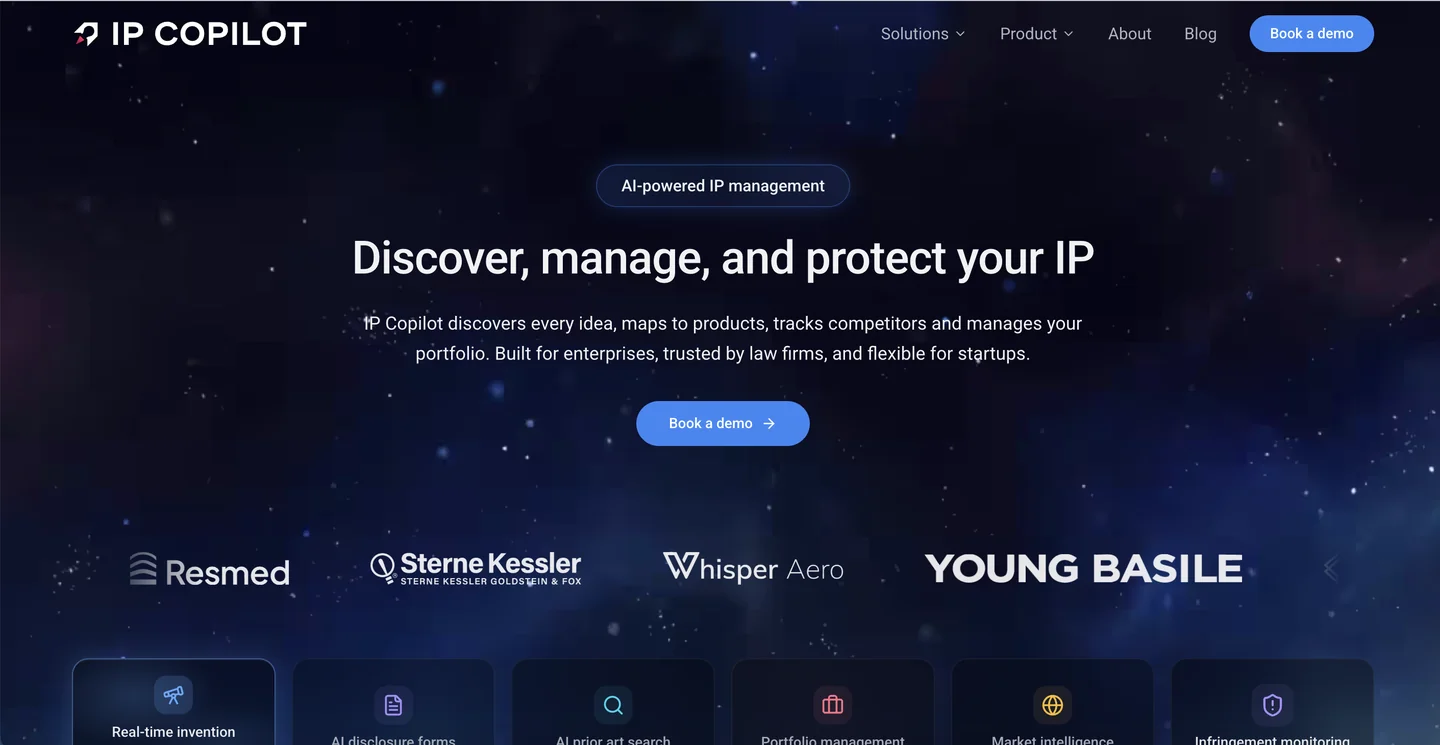
What it is: IP Copilot is the closest thing the market has to a dedicated invention mining platform. Founded in 2023, the product is designed to review internal communications and engineering systems — including tools such as Slack, Jira, Confluence, GitHub, Google Drive, Zoom, and presentation materials — then surface potentially patentable ideas for IP-team review before anyone submits a formal disclosure.
Pros:
- Finds invention signals automatically across connected engineering and communication tools.
- Best fit for large technical organizations where the IP team cannot manually follow every project.
- Surfaces ideas before an employee decides to complete a disclosure form.
Cons:
- Produces potential leads that still need review, prioritization, and a separate path to drafting and filing.
- Likely offers limited value for smaller teams where leadership already has visibility into most technical work.
Pricing: Pricing is customized based on company size, integrations, and deployment requirements.
Best for: Mid-size to large companies (100+ engineers) with active internal communication platforms who suspect significant inventions are going unrecognized.
3. Tradespace: full-lifecycle IP platform with invention harvesting
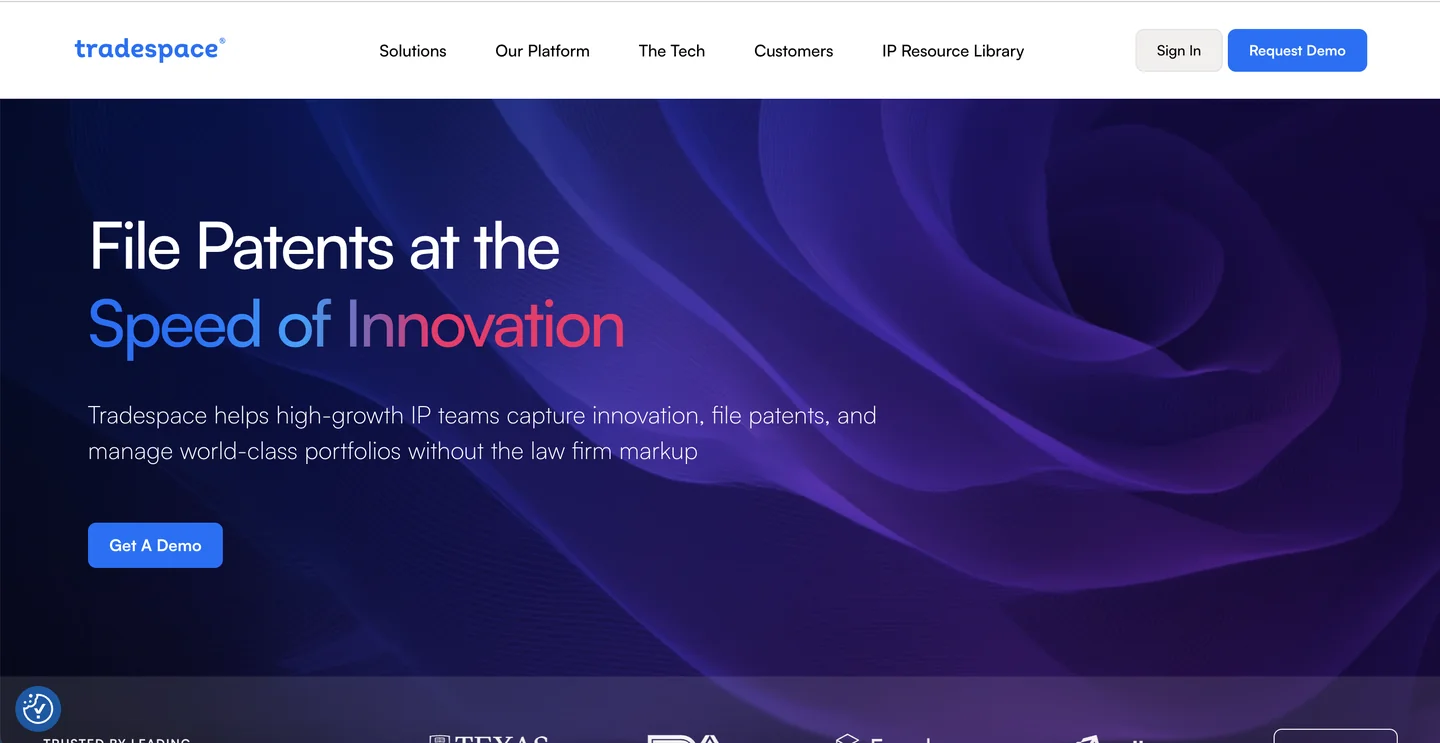
What it is: Tradespace is an end-to-end AI IP platform that spans invention harvesting, patent drafting, prosecution, portfolio management, and commercialization. Its invention harvesting module integrates with engineering tools to surface potentially patentable concepts. For patent filings, Tradespace can also connect companies with attorneys in its network, who review and revise AI-generated application drafts.
Pros:
- Connects invention harvesting to a broader platform for disclosures, drafting, prosecution, and portfolio management.
- Strong fit for established IP teams that want to consolidate several patent workflows in one system.
- Can build disclosures from technical materials that already exist instead of relying entirely on inventor-written forms.
- Offers access to outside attorneys within the same platform for companies that need filing support.
Cons:
- A broad enterprise platform may be more complex than necessary for companies primarily trying to improve invention discovery.
- Companies need an internal IP function capable of operating the platform and making the filing decisions it supports.
- Its filing model relies on attorneys reviewing AI-generated drafts, which may appeal less to companies looking for a more directly agent-led drafting process.
Pricing: Tradespace's platform has been publicly listed by LawNext at $500 per month, although current pricing may vary by modules, users, and deployment.
Best for: In-house IP teams at companies with 50+ engineers who want to consolidate invention harvesting, drafting, prosecution, and portfolio management into a single platform.
4. Patlytics: adjacent tool for whitespace and portfolio gap analysis
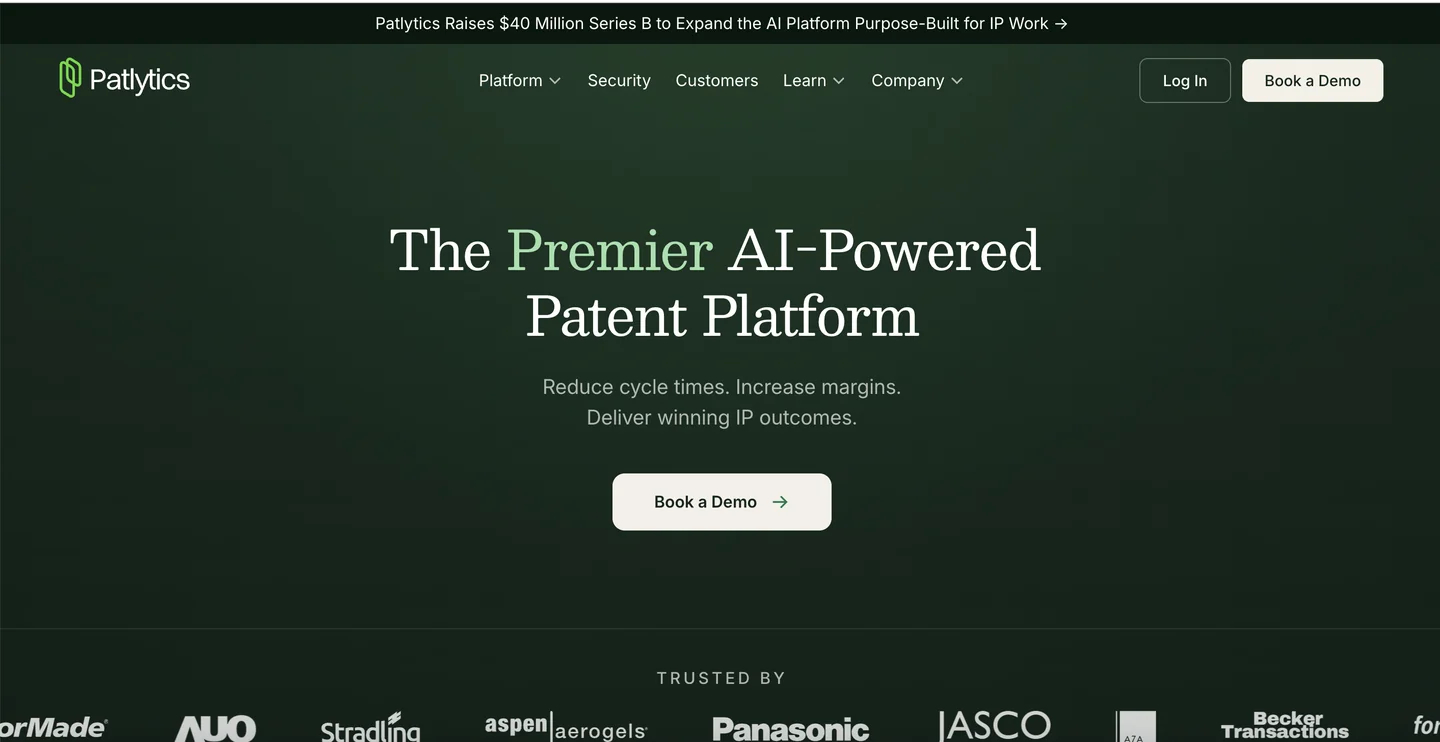
What it is: Patlytics is an AI-powered patent intelligence platform focused on analysis, enforcement, and portfolio strategy. Patlytics doesn't approach invention mining the same way as IP Copilot or Tradespace. Rather than scanning internal communications for hidden ideas, Patlytics helps teams identify where to innovate by analyzing the competitive patent landscape and finding gaps.
Pros:
- Strongest option for identifying filing opportunities through patent landscapes, competitor activity, and portfolio gaps.
- Combines disclosure work with prior-art analysis, patent intelligence, and enforcement-oriented tools.
- Useful for sophisticated IP teams making strategic portfolio decisions across many technologies.
Cons:
- Does not primarily find inventions hidden inside day-to-day engineering work.
- Its analytical depth and broader feature set may be unnecessary for companies that simply need to capture and advance internal ideas.
Pricing: Patlytics does not publish rates. Third-party estimates range from approximately $800 to $2,500 per month, with some sources estimating annual small-team contracts of $25,000-$75,000.
Best for: In-house IP teams and law firms that want to identify strategic filing opportunities through competitive landscape analysis rather than mine internal communications for inventions.
5. Triangle IP: disclosure management with idea capture
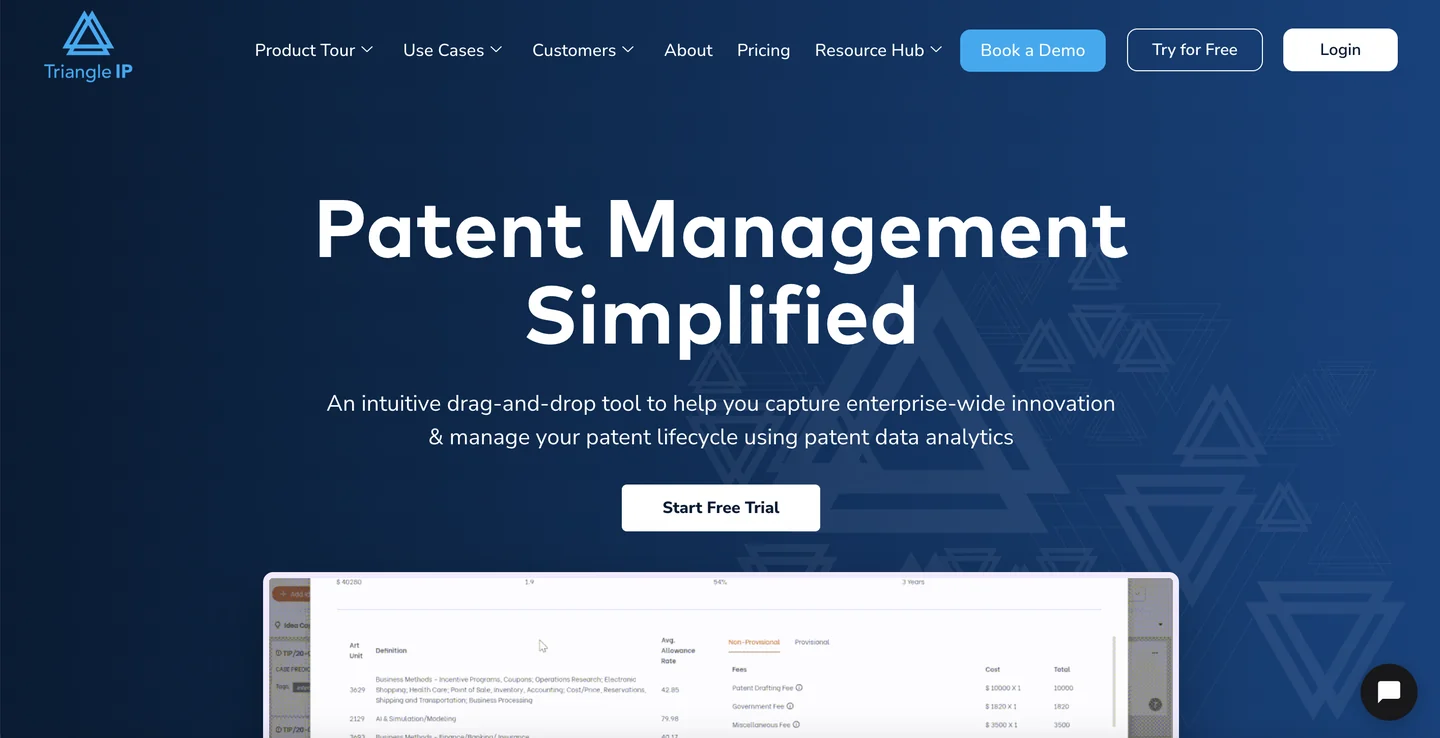
What it is: Triangle IP's TIP Tool is a patent portfolio management platform with a strong focus on the disclosure intake process. The tool uses a drag-and-drop interface to move ideas through stages — idea capture, internal vetting, patent drafting, filing — with role-based access for inventors, managers, prosecutors, and IP teams. The philosophy is that more inventions get captured when the submission process is simple and transparent.
Pros:
- Makes it easier for employees to submit ideas through a simple, approachable disclosure workflow.
- Provides clear pipeline visibility for patent committees reviewing and prioritizing submissions.
- Transparent, accessible pricing makes it practical for smaller teams.
Cons:
- Relies on employees recognizing an invention and choosing to submit it; it does not proactively find hidden ideas.
- Stops primarily at intake and workflow management, so drafting and filing require a separate provider.
Pricing:
- Free for up to 10 users
- $50/month or $500/year for Premium
Best for: Organizations replacing manual tracking or spreadsheet-based processes with a structured system.
6. InspireIP: invention harvesting through employee engagement
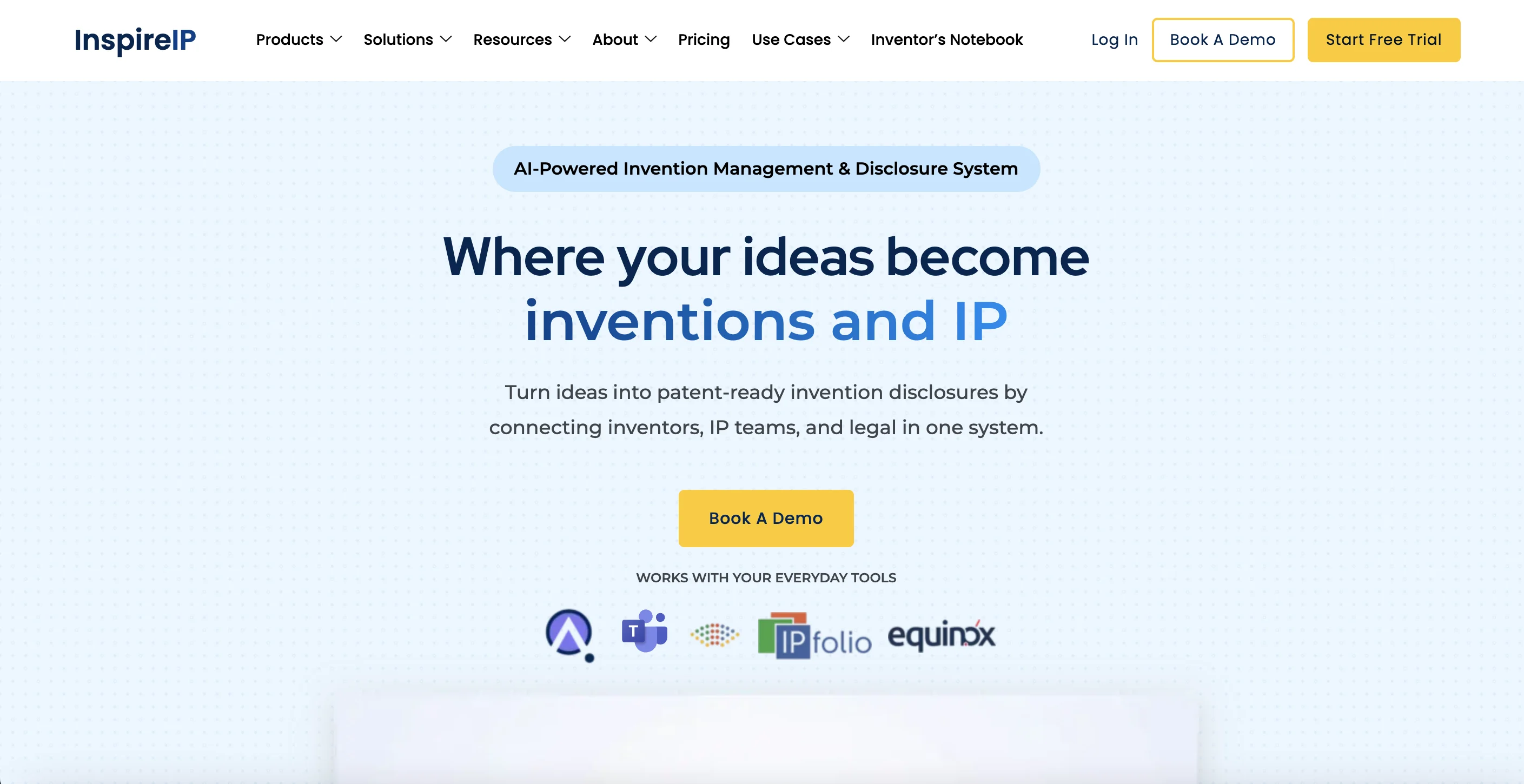
What it is: InspireIP is an innovation and invention disclosure platform designed to help companies collect more ideas from employees and move promising concepts into the patent process.
Pros:
- Gives companies a structured way to run invention-harvesting initiatives and encourage more employees to participate.
- Uses guided forms and AI assistance to turn rough ideas or existing documents into more complete invention disclosures.
- Includes evaluation workflows, prior-art searching, and patent committee views to help IP teams decide which disclosures should move forward.
- Can integrate with workplace tools such as Microsoft Teams and Slack, as well as IP management systems including Anaqua, IPfolio, and Symphony.
Cons:
- The platform still depends largely on employees actively submitting ideas or participating in invention-harvesting programs.
- Companies generally need an IP or innovation team to evaluate submissions and coordinate with outside counsel.
Pricing: InspireIP lists its Idea Assist plan at $1,799/month with unlimited users. Pricing for IP Assist — which includes invention disclosures, novelty checking, external attorney collaboration, and docketing integrations — is customized.
Best for: Established companies, universities, and law firms that want to increase inventor participation and introduce a more structured process for capturing, reviewing, and advancing employee-submitted inventions.
How to choose the right invention mining approach
The right tool depends on where inventions are currently getting lost, and what your company needs to happen after an opportunity is identified.
If inventions are buried across a large organization
IP Copilot is built for companies with technical activity spread across many teams and internal systems. It continuously scans connected tools to surface potential inventions that an IP team may never encounter through a traditional disclosure process.
Its value is concentrated at the discovery stage. Companies still need a separate process for evaluating the results, deciding what to protect, and moving selected opportunities into drafting and filing.
If you want invention mining connected directly to patent execution
Patentext is designed for companies that do not merely want a feed of possible inventions. The platform analyzes work across systems such as GitHub, Slack, and Google Drive and surfaces opportunities for the company to review inside Patentext.
From there, teams can develop the technical record, compare opportunities against business priorities, and decide which inventions warrant investment. When the company approves an invention for filing, USPTO-registered patent agents through Patentext Services prepare and file the application using the context already captured in the platform.
This makes Patentext strongest for startups and growing technical companies that want one connected path from internal technical work to a professionally prepared patent application, without assembling separate mining, disclosure, workflow, and filing providers.
If you already have a mature internal IP function
Tradespace is built for organizations with established IP teams that want invention harvesting inside a broader enterprise platform. Its tools extend beyond discovery into disclosure management, drafting, prosecution workflows, portfolio operations, and commercialization.
That breadth is most useful when a company already has internal patent professionals who can configure the workflows, evaluate the output, and manage the resulting portfolio.
If your priority is finding strategic gaps in the market
Patlytics takes a different approach. Rather than primarily looking through internal engineering work for inventions, it analyzes patent landscapes, competitor activity, and existing portfolios to identify areas where additional innovation or patent coverage may be valuable.
It is best suited to sophisticated IP teams using patent intelligence to shape portfolio strategy, rather than companies primarily trying to uncover inventions already being created internally.
If employees recognize inventions but rarely submit them
Triangle IP focuses on reducing the friction of invention disclosure. Its simple intake experience and visible review pipeline make it easier for employees to submit ideas and for patent committees to move them toward a decision.
It does not proactively discover ideas hidden in engineering work, but it can improve the percentage of recognized inventions that actually reach the IP team.
Frequently asked questions
What is invention mining software?
Invention mining software helps organizations proactively identify potentially patentable ideas from internal workflows, communications, and engineering output — before anyone submits a formal disclosure. The category ranges from passive communication scanners to structured discovery frameworks to competitive landscape analyzers.
How is invention mining different from invention disclosure management?
IP disclosure management tools process ideas after someone recognizes and submits them. Invention mining tools go upstream: they help find ideas that nobody has recognized yet, or ensure that recognized ideas reach the pipeline faster.
Can general AI tools like ChatGPT replace dedicated invention mining software?
Not directly. General-purpose AI tools can help pressure-test ideas and structure early-stage thinking, but they don't integrate with internal communication platforms, maintain portfolio context, or perform reliable prior art searches. They're useful as part of a lightweight internal process but don't replace the systematic scanning, scoring, and workflow capabilities of dedicated tools.
What size company needs invention mining software?
There's no strict threshold, but the problem becomes acute when the ratio of engineers to IP professionals makes manual oversight impossible. The need usually appears when technical work is distributed across enough teams that one person cannot reliably review product and engineering activity manually. Smaller, closely coordinated teams may be able to use a structured internal process until the volume and complexity justify dedicated software.
Disclaimer: This article is for informational purposes only and does not constitute legal advice. Patent laws are complex and vary by jurisdiction. For personalized guidance, consult a qualified patent attorney or agent.