Patent portfolios can fall apart for plenty of reasons. Bad strategy and poor timing are two common culprits. For growing companies, however, another frequent problem is that nobody owns the process between "we should patent that" and an actual filing — even as the number of inventions, product lines, and stakeholders keeps growing.
Patent management software replaces the patchwork of spreadsheets, shared drives, email threads, calendar reminders, and ad hoc invention pipelines. Depending on the product, it may centralize invention intake, deadline management, filing workflows, portfolio reporting, or patent analytics.
This guide covers ten options across the full spectrum — from enterprise systems built for companies with thousands of patents to tools designed for startups building their first portfolio.
What is patent management software?
Patent management software centralizes the workflows around building and maintaining a patent portfolio. At the most basic level, it replaces the combination of spreadsheets, shared drives, email threads, and calendar reminders that most companies use before they outgrow them.
That said, patent management software is a broad category rather than a single product type. It spans two ends of the patent lifecycle: platforms that help companies identify and advance new inventions, and systems that administer existing applications, deadlines, and granted patents. Some products cover both, but most are stronger at one end. The category includes several distinct jobs:
- Docketing and deadline management is the operational core for firms and corporate teams. Patent prosecution involves statutory deadlines that vary by jurisdiction, and missing one can mean losing rights permanently. Enterprise platforms automate date calculation and jurisdiction-specific rules.
- Invention intake and disclosure management covers the earlier stage — capturing ideas from engineers and researchers, routing them through internal review, and deciding what's worth filing. This is where growing companies often have the biggest gap.
- Portfolio tracking and reporting gives visibility into the status of every application, grant, and maintenance fee across the portfolio. This becomes critical as the patent count grows and as leadership needs reporting for board meetings, fundraising, or M&A diligence.
- Analytics and competitive intelligence is where enterprise platforms differentiate — patent landscape analysis, examiner statistics, competitive benchmarking, and cost forecasting.
- Filing and prosecution workflow connects the management layer to the actual patent preparation and filing process. Some platforms integrate directly with patent offices; others stop at tracking.
Quick comparison
| Platform | Primary category | Best for | Public starting price |
|---|---|---|---|
| Patentext | Invention-to-filing | Startups and growing technical companies | $0 to start; paid plans from $2,700/year |
| Anaqua AQX | Enterprise IP management | Large corporate IP teams | Custom |
| FoundationIP | Law firm docketing | IP law firms | Custom |
| IPfolio | Corporate portfolio management | Mid-size and large corporate IP teams | Custom |
| IP Copilot | IP management | Corporate IP teams seeking automated invention discovery | Custom |
| AppColl | Prosecution management | Small and mid-size IP teams | $100/user/month |
| Triangle IP | Invention capture | R&D and innovation teams | $0; Premium $50/month |
| Patlytics | Patent intelligence | Analytics-heavy IP teams | Custom |
| Alt Legal | Lightweight docketing | Small teams and boutique firms | $60/month plus matter tier |
| PatSnap | Patent intelligence | Large R&D organizations | Custom |
10 of the best patent management software platforms in 2026
1. Patentext
Category: Invention-to-filing platform
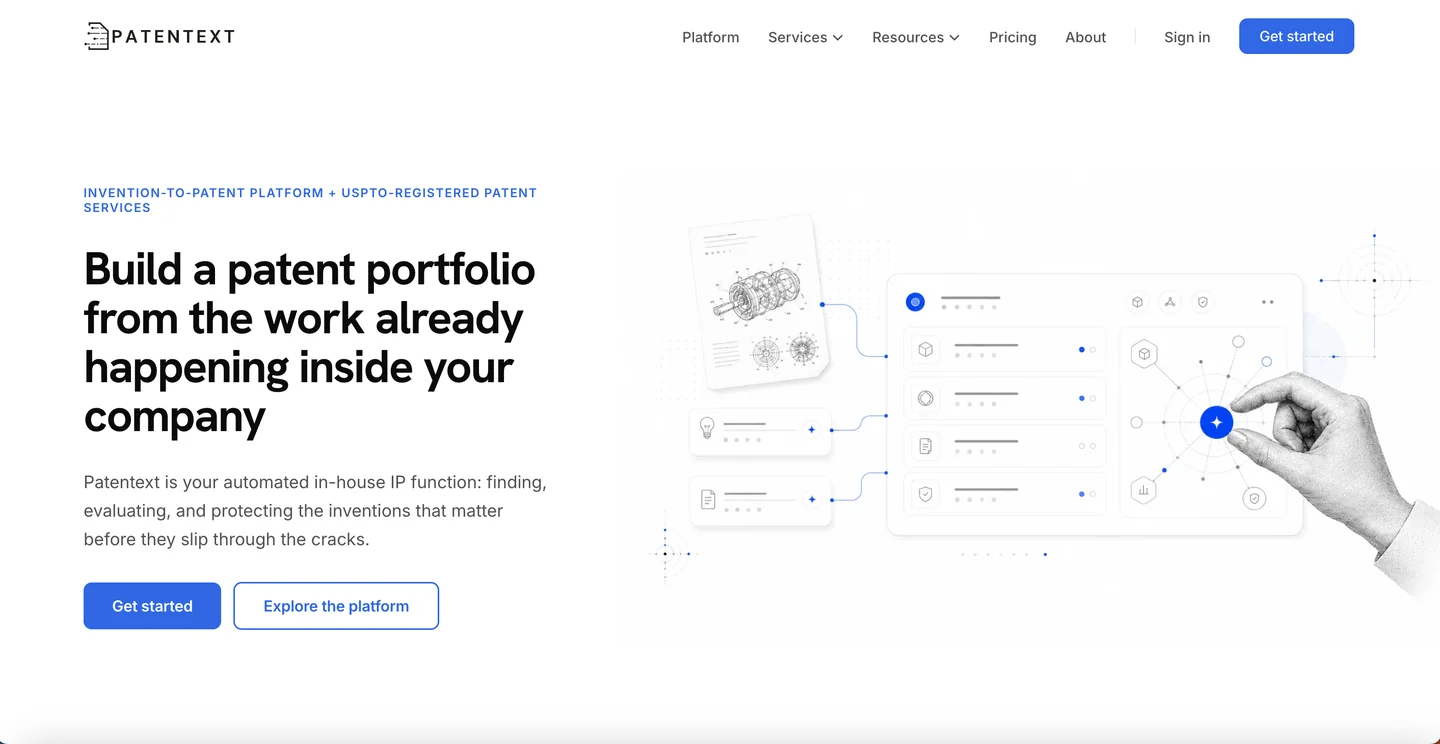
Patentext is an invention-to-patent platform designed for companies that need to build a patent process, not just administer an existing portfolio. It combines structured invention capture, evaluation workflows, portfolio visibility, and patent application drafting and filing delivered by USPTO-registered patent agents through its Services arm.
Key features
- Guided patent strategy workflow for evaluating inventions against technical, commercial, and disclosure-risk factors
- Structured invention disclosure and capture
- Portfolio visibility with application tracking and status management for matters handled through Patentext
- Flat-fee provisional ($3,600) and non-provisional ($4,700-$5,700) drafting and filing through Patentext Services
Pros
- Starts at invention identification, not docketing — which is where growing companies actually start
- Connects invention decisions to professional filing in one end-to-end workflow
- Designed for founders and engineers, not patent paralegals
- Transparent pricing with no hourly billing surprises
- Free tier available for early exploration
- Patent agents use the technical and strategic context already captured in the platform when preparing applications
Cons
- Not a full-featured docketing system
- Currently focused on US patent work, though its Services arm can handle PCT applications
- Smaller company and newer platform compared to established enterprise vendors
Pricing: Free tier for strategy and disclosure tools. Paid plans are $2,700/year for unlimited strategy and disclosure workflows. Patentext Services offers provisional patent applications at $3,600 and non-provisional applications at $4,700-$5,700.
Best for: Startups and growing technical companies that need to build a repeatable patent pipeline without hiring in-house patent counsel.
2. Anaqua (AQX)
Category: Enterprise IP management

Anaqua's AQX platform is an established enterprise IP management system that combines patent and trademark management with analytics, financial tracking, and workflow automation in a unified SaaS environment.
Key features
- Automated docketing with patent office integrations across multiple jurisdictions
- Invention disclosure management and innovation capture
- Portfolio analytics with competitive intelligence
- Financial tracking and IP cost management
- Configurable workflows, templates, and approval processes
- Integration with document management, billing, and enterprise systems via API
Pros
- Deep docketing infrastructure with broad jurisdiction coverage
- Strong analytics and business intelligence capabilities
- Handles patents, trademarks, and broader IP in one system
- Active product development and regular feature releases
- Trusted by large enterprise users and major law firms
Cons
- Designed for enterprise scale; requires significant implementation and configuration investment
- Pricing is not publicly disclosed and is described by reviewers as expensive
- Onboarding and setup timelines can extend to months
- Feature depth can be overwhelming for teams with small portfolios
- Users report that screen transitions can be slow
Pricing: Custom enterprise pricing. Implementation and configuration costs vary significantly by portfolio size, modules, integrations, and migration requirements.
Best for: Large corporations and law firms managing hundreds or thousands of matters across multiple jurisdictions.
3. FoundationIP (Clarivate)
Category: Law firm docketing and prosecution
FoundationIP is Clarivate's cloud-based IP management solution built specifically for law firms. It focuses on prosecution workflow, docketing, and outside counsel coordination.
Key features
- One-click docketing with automated task generation
- Clarivate IP data integration with automatic law updates and recalculations across 300+ jurisdictions
- Patent family tree visualization with priority lineage and terminal disclaimer tracking
- Collaboration portal for outside counsel coordination
- Configurable dashboards and KPI reporting
- Manages patents, trademarks, copyrights, and designs in one system
Pros
- Deep prosecution workflow automation for law firms
- Reliable jurisdiction data with updates three times annually
- Strong outside counsel collaboration tools
- Scales from boutique to large firm operations
- Backed by Clarivate's broader IP data and services ecosystem
Cons
- Built for law firms, not corporate IP teams
- Pricing is quote-based and skews enterprise
- Return on investment timeline averages around 29 months per user reviews
Pricing: Quote-based enterprise pricing. Third-party estimates suggest $30,000 to $100,000+/year depending on firm size and configuration.
Best for: IP law firms that need prosecution-grade docketing and deadline management at scale.
4. IPfolio (Clarivate)
Category: Corporate portfolio management
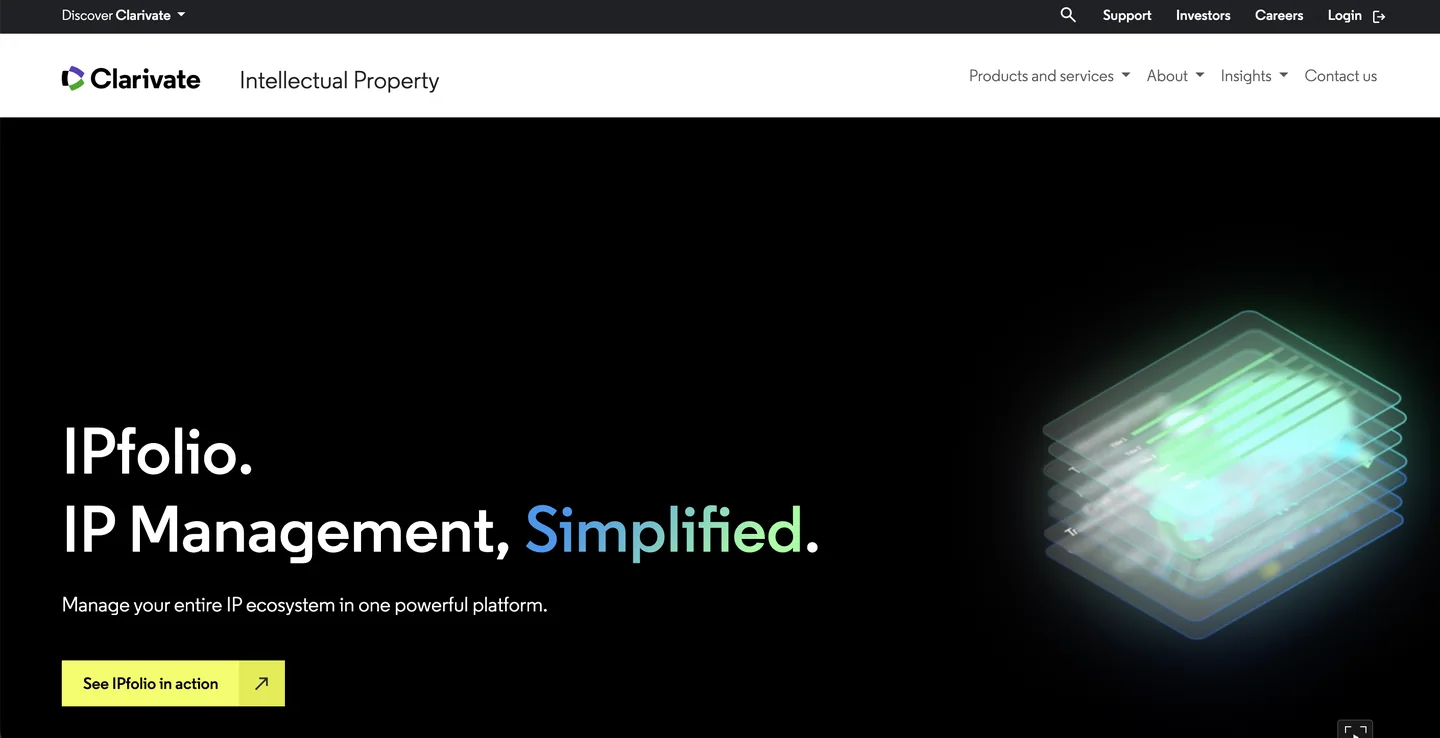
IPfolio is Clarivate's IP management platform designed specifically for corporate IP teams, built on the Salesforce platform. Where FoundationIP serves law firms, IPfolio serves in-house teams that need portfolio visibility, workflow automation, and strategic reporting.
Key features
- Configurable inventor portal for invention disclosure intake
- Patent, trademark, and design management in one system
- Custom workflows, fields, dashboards, and reports
- Integration with Clarivate IP data sources (Derwent, CompuMark, Innography)
- Financial tracking with cost forecasting
- Built on Salesforce; inherits its security model and UI patterns
Pros
- Highly configurable with custom fields, workflows, and dashboards
- Strong inventor portal for disclosure management
- Clean integration with Clarivate's broader IP ecosystem
- Intuitive Salesforce-based UI with regular automatic updates
Cons
- Can feel overwhelming due to the number of features and configuration options
- Pricing is not transparent and requires sales engagement
- Salesforce dependency may be a pro or a con depending on your existing stack
- Best suited for teams with some IP operations maturity
- Configuration flexibility means setup takes intentional planning
Pricing: Custom enterprise pricing through Clarivate sales.
Best for: Mid-size to large corporate IP teams that want configurable portfolio management with strong data integration and analytics.
5. IP Copilot
Category: AI-powered invention and IP management
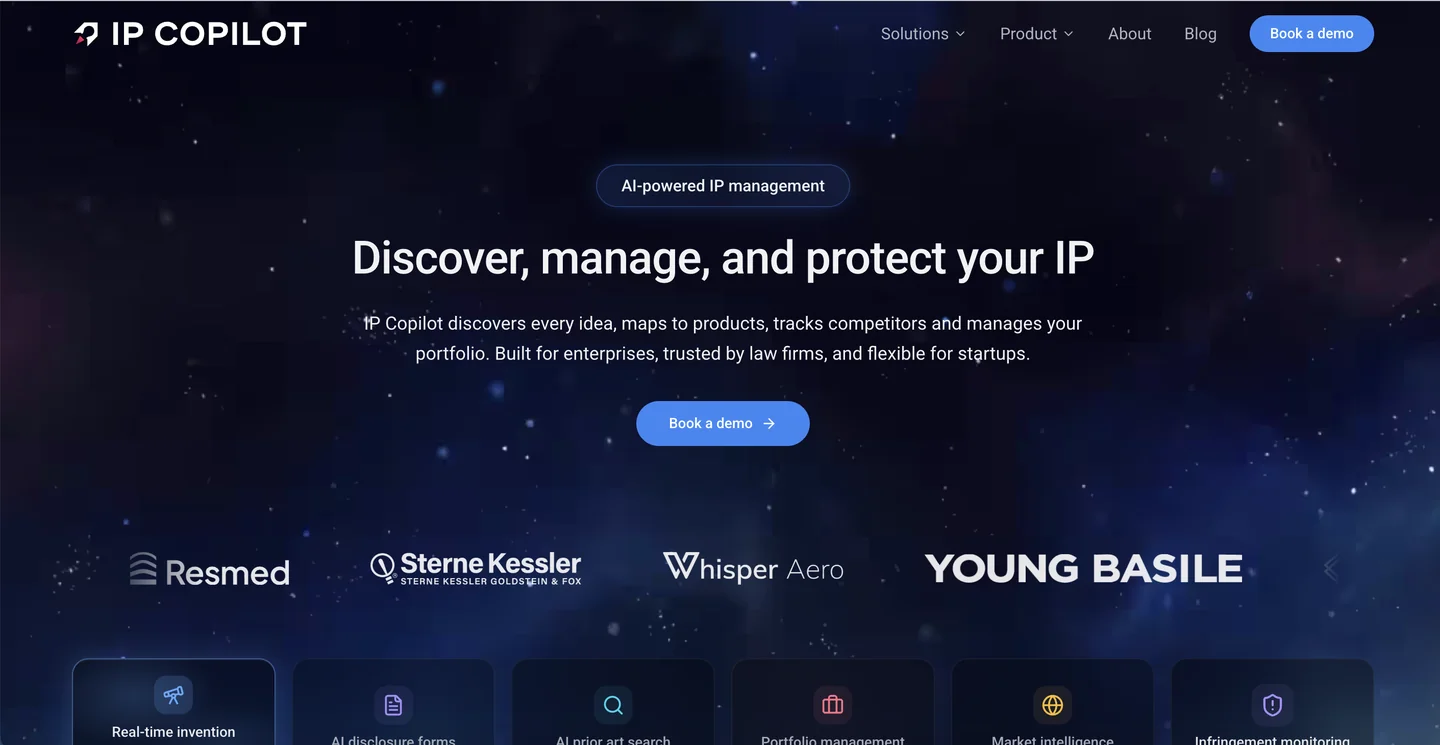
IP Copilot is an AI-powered IP management platform designed to help corporate IP and innovation teams identify patentable ideas, improve invention disclosures, evaluate filing opportunities, and manage the resulting portfolio. Its invention-harvesting capabilities can surface potential IP from systems such as Slack, Jira, Confluence, GitHub, SharePoint, and Microsoft Teams — allowing companies to find inventions within work already being documented by technical teams.
Key features
- Automated invention harvesting across engineering, collaboration, and document-management systems
- Guided invention disclosure forms that organize technical information and identify areas requiring additional inventor input
- AI-powered prior-art searches across patent databases, technical literature, and the open web
- Filing-decision workflows that analyze disclosures, surface potentially distinctive features, and generate early claim candidates
- Competitive intelligence, product monitoring, and claim-level infringement analysis
Pros
- Proactively identifies potential inventions rather than relying entirely on employees to submit disclosures
- Covers much of the workflow from initial idea discovery through filing analysis and portfolio management
- Integrates with systems engineers and product teams already use
Cons
- Does not provide integrated drafting and filing services
- Best suited to companies that already have in-house patent professionals or outside counsel available to review its output and complete the legal work
- Broad feature set may be more platform than a small company with only a few potential inventions needs
Pricing: IP Copilot does not publish standard subscription tiers. Pricing likely varies based on company size, integrations, deployment requirements, and selected modules.
Best for: Companies with an existing IP team or established outside counsel relationships that want to automate invention discovery, strengthen disclosures, and give patent professionals more complete information before drafting begins.
6. AppColl
Category: Prosecution and invention management
AppColl is a cloud-based IP management platform built for both law firms and corporate IP teams. It takes a modular approach: the Prosecution Manager handles docketing, matters, and workflow, while the separate Invention Manager covers corporate disclosure intake and patent committee processes.
Key features
- Automated docketing for US patents and trademarks with USPTO integration
- Customizable workflow templates and email notifications
- Prior art management and document storage
- Reporting with scheduled custom reports
- Time tracking, billing, and invoicing
- Contact and client management
- Auto-populated PTO forms
- Separate Invention Manager module for corporate disclosure workflows
Pros
- Transparent pricing starting at $100/user/month
- Cloud-native with no long-term contracts required
- Fast onboarding — automated data import from Patent Center and TSDR in 1-2 days
- Highly customizable workflows that adapt to different team structures
- Strong customer support ratings (4.7/5 on G2 with 40+ reviews)
- Modular — pay for the workflow coverage you need
Cons
- Primarily US-focused for automated docketing; international coverage is less mature
- Billing system could be more advanced per user reviews
- Invention Manager is a separate product from Prosecution Manager
- Less suited for teams that need deep analytics or competitive intelligence
- Smaller vendor compared to Clarivate or Anaqua
Pricing: Prosecution Manager starts at $100/user/month (PM Pro plan). Invention Manager pricing is separate.
Best for: Small to mid-sized law firms and corporate IP teams that want configurable docketing and matter management without enterprise pricing or a months-long implementation.
7. Triangle IP (TIP Tool)
Category: Invention capture and evaluation
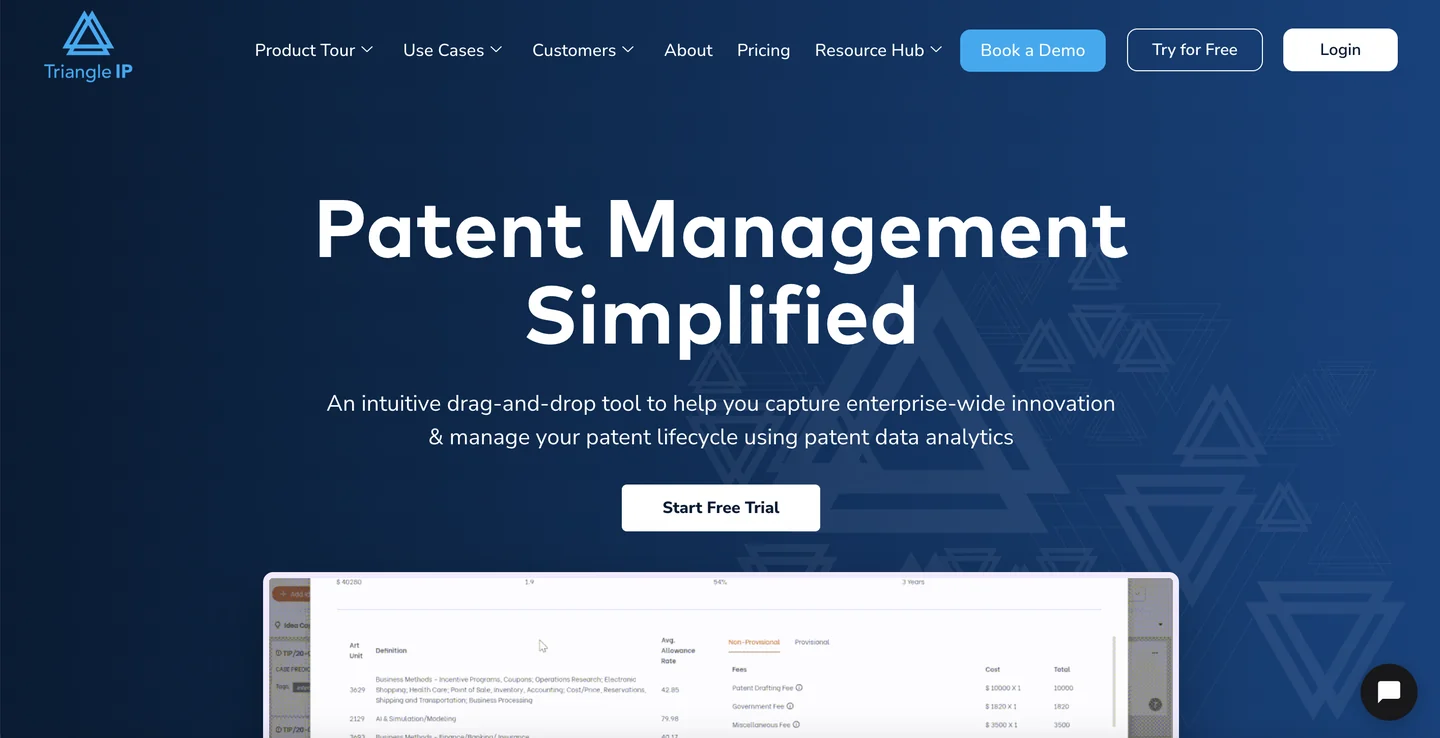
Triangle IP's TIP Tool is a patent lifecycle management platform focused on idea capture, invention evaluation, and patent pipeline visibility. It uses a drag-and-drop interface inspired by project management tools to make patent workflows accessible to non-IP-specialists.
Key features
- Intuitive invention disclosure form that can be customized per organization
- Drag-and-drop workflow for moving inventions through pipeline stages
- Tagging and filtering by technology, product line, or business unit
- Real-time collaboration with commenting and version history
- Automatic USPTO status syncing via Private PAIR
- Case analytics with examiner insights and art unit prediction
- Patent cost estimation tools
Pros
- Free plan available (up to 10 users, 5 GB storage, one portfolio)
- Jira-inspired interface that engineers and product managers can use without IP training
- Strong focus on the front end of the patent lifecycle — idea capture and evaluation
- No per-user licensing friction at the paid tier
- Includes useful analytics like art unit prediction and examiner insights
Cons
- Lighter on docketing and prosecution management than platforms like AppColl or Anaqua
- Doesn't include patent preparation services
- Less established than enterprise competitors; limited independent review data
- Data import from existing systems may require manual assistance during onboarding
Pricing: Free plan: $0 (up to 10 users, 1 portfolio). Premium: $50/month or $500/year, flat-rate per organization (up to 100 users). Custom pricing for enterprise.
8. Patlytics
Category: Patent intelligence and analytics

Patlytics is an AI-native patent intelligence platform that covers patent analysis, claim charting, infringement detection, and portfolio management. It recently expanded into invention disclosure automation, positioning itself as a full patent lifecycle platform for enterprise IP teams.
Key features
- AI-powered claim charting and infringement detection
- Prior art search and invalidity analysis
- Portfolio analytics and competitive intelligence
- Automated invention disclosure form (IDF) workflow (launched May 2026)
- Patent prosecution workflow automation
- Collaboration tools for multi-team patent research
Pros
- Broad lifecycle coverage from disclosure through litigation support
- Used by both corporate teams and law firms
- Active product development with regular feature releases
Cons
- Implementation costs can add $10,000-$50,000 for enterprise deployments
- Analytics-heavy focus may be more depth than growing companies need
- Advanced features have a learning curve for teams new to patent analytics
- Invention disclosure features are very new (launched May 2026)
Pricing: Third-party estimates place pricing at $800-$2,000/user/month with additional implementation, data migration, and integration costs.
Best for: Teams that already have a portfolio and need analytical depth — not for companies still figuring out what to file.
9. Alt Legal
Category: IP management and docketing
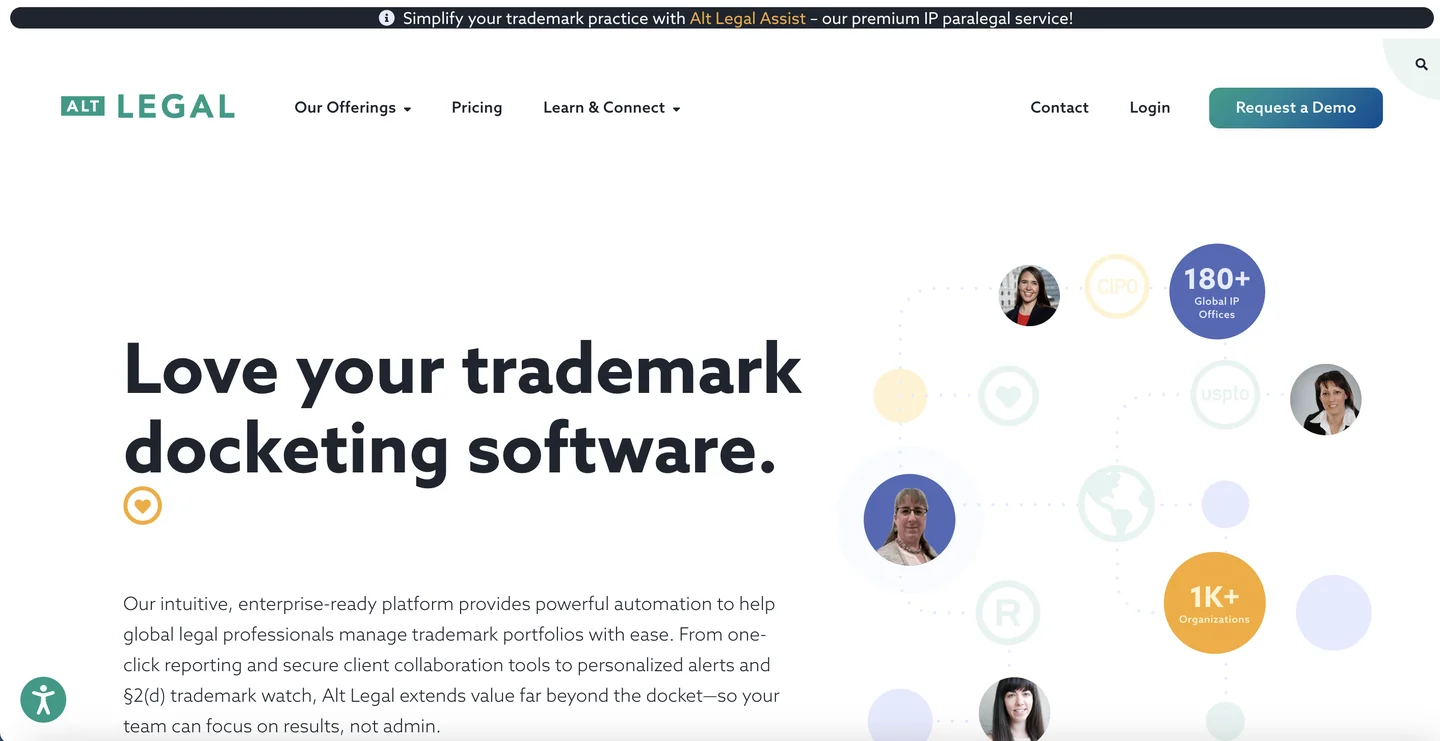
Alt Legal is a cloud-based IP docketing platform that connects to over 180 international IP offices to automate deadline tracking. While it started as a trademark docketing tool (and that remains its core strength), it also handles patent matters.
Key features
- Automated docketing from USPTO and CIPO with data from 180+ global IP offices
- One-click reporting and smart email templates
- Personalized email alerts and calendar sync
- USPTO Trademark Center integration
- Client and stakeholder collaboration tools
- Optional Alt Legal Assist (IP paralegal services)
- Optional Alt Legal Trademark Protection (global monitoring)
Pros
- Transparent, affordable pricing starting at $60/month
- Matter-based pricing keeps costs predictable for small teams
- Very fast setup
- Low administrative overhead compared to enterprise platforms
- Free trial available
Cons
- Trademark-heavy — patent docketing capabilities are less mature than dedicated patent platforms
- Not designed for invention management, disclosure capture, or portfolio strategy
- Limited analytics compared to platforms like Patlytics or Anaqua
- Matter-based pricing means costs scale with portfolio growth
- Less depth in patent prosecution workflows
Pricing: Plans start at $60/month + $30/month for up to 50 matters. Scales to $195/month + $60/month (up to 200 matters) and $295/month + $95/month (up to 400 matters). Custom pricing for larger portfolios. Free trial available.
Best for: Small IP teams and boutique firms that need lightweight, reliable docketing without enterprise setup or pricing.
10. PatSnap
Category: Patent intelligence and R&D strategy
PatSnap is an enterprise patent intelligence and innovation management platform used by large R&D organizations for patent landscaping, competitive analysis, and portfolio strategy. It combines a massive patent database with AI-powered analytics and visualization tools.
Key features
- Global patent database with semantic search across 170+ million documents
- Patent landscape analysis and white-space identification
- Competitive intelligence and technology trend tracking
- Innovation workflow management connecting R&D to IP strategy
- Custom analytics dashboards and visualization
- AI-powered summarization and prior art analysis
Pros
- One of the most comprehensive patent data and analytics platforms available
- Strong visualization and landscape analysis tools
- Useful for R&D strategy, not just patent operations
- Handles multi-national portfolio analysis across global datasets
- Enterprise-grade security and compliance
Cons
- Enterprise pricing (typically $500+/month per user) puts it out of reach for most startups
- Built for large R&D organizations with dedicated innovation or IP teams
- Not a docketing, filing, or prosecution tool
- Significant learning curve for users new to patent analytics
- Overkill for companies with fewer than 50 patents or a small R&D footprint
Pricing: Typical starting points are $500+/month per user with annual contracts.
Best for: Large corporations and R&D organizations that need patent landscape intelligence, competitive analysis, and innovation workflow management.
How to evaluate patent management software
Does the platform start where your work actually starts?
Most patent management software assumes you already have patents to manage. If your company's primary challenge is identifying which inventions to protect and moving them through an internal review process, a pure docketing platform solves the wrong problem.
Can non-specialists use it?
In a startup, the people closest to patentable inventions are engineers, product managers, and founders — not patent paralegals. If the software requires IP training to operate, adoption will stall.
What's the real cost at your scale?
Enterprise platforms often price by portfolio size, user count, and module. A system that costs $30,000/year for a 200-person IP department may cost $10,000/year for a 5-person team that only uses a fraction of the features. Always ask for pricing at your actual scale, not the published enterprise tier. For a broader breakdown of what patent work costs at the startup stage, see our guide on how much it costs to patent a startup idea.
Does it connect invention decisions to filing work?
The most common challenge for growing companies isn't missing a deadline — it's never getting inventions into the pipeline in the first place. The best patent management software for this stage connects the decision about whether to file with the process of actually filing.
How to match patent management software to your company stage
The right platform depends less on features and more on where your company sits in its IP maturity:
- No patents yet, evaluating whether to file: You don't need portfolio management software. You need a way to capture inventions, evaluate what's worth protecting, and connect that process to professional filing. Patentext and Triangle IP's TIP Tool both address this stage, with Patentext adding integrated patent agent services for the filing step.
- A few patents, growing the portfolio: AppColl and Alt Legal offer the docketing and matter management infrastructure you'll start needing without enterprise complexity or pricing. If your challenge is also generating and evaluating the next round of inventions,Patentext's platform layer connects that upstream work to the filing process.
- Dozens of patents, building an IP operations function: IPfolio provides the portfolio-management infrastructure a growing IP team needs, while IP Copilot adds automated invention discovery, disclosure analysis, and competitive intelligence. At this scale, you likely also have outside counsel relationships that benefit from coordination tools.
- Hundreds of patents, enterprise IP operations: Anaqua, FoundationIP, and PatSnap serve the needs of mature IP departments with dedicated staff, complex multi-jurisdiction portfolios, and strategic analytics requirements.
The gap most patent management platforms don't address
Most platforms in this comparison are built around the same assumption: you already have patents, applications, or at least invention disclosures ready to enter the system. The software manages what happens after the portfolio exists.
For growing companies, the harder problem is usually what happens before the portfolio exists. Which inventions coming out of R&D and product development are worth protecting? Who decides? How do you capture enough technical context to support a quality application? How do you avoid the common traps that sink early-stage patent efforts?
If those questions describe your situation more accurately than "we need better docketing," the evaluation criteria shift. You're looking for a system that helps your team identify, evaluate, and act on patentable inventions — and connects that process to professional filing without requiring you to build an IP department first.
Patentext is built for that workflow. The platform helps companies manage inventions and filing decisions, while USPTO-registered patent agents prepare applications using the structured context captured upstream. Explore the Patentext platform.
Disclaimer: This guide is based on publicly available information, including official company websites, published reviews, product documentation, and third-party pricing estimates. Features, pricing, and capabilities may change over time. Pricing estimates should be verified directly with vendors.